
Table of Contents
- Material Comparison for Cellar Entrance Doors
- Steel Bulkhead Doors: Durability and Security
- Fiberglass Exterior Basement Doors: Moisture and Rust Resistance
- Wood Cellar Doors: Appearance and Maintenance
- Cellar Door Weatherproofing: Seals, Drainage, and Insulation
- Bulkhead Cellar Door Replacement: Cost and Service Life
- Conclusion: Choosing the Right Material for Your Cellar Entrance
- Frequently Asked Questions
Last Updated: October 8, 2026
Material Comparison for Cellar Entrance Doors
Choosing the best materials for exterior cellar entrance doors comes down to how much water, traffic, and maintenance each option can handle.
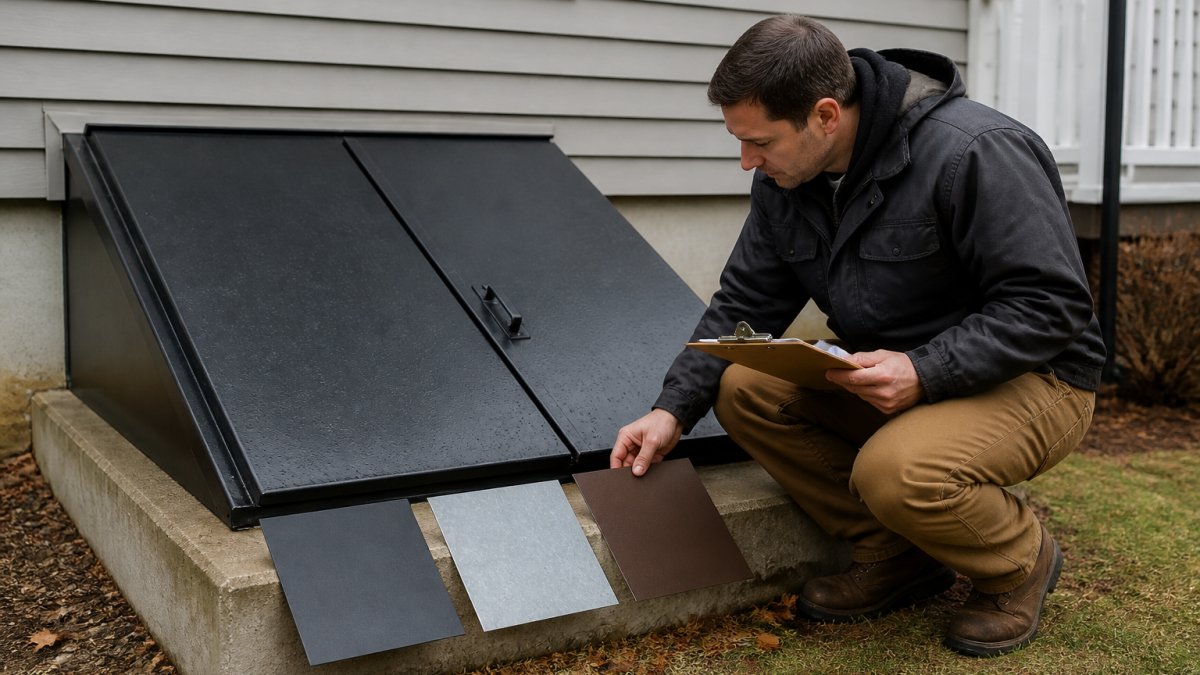
For most cellar entrances, we recommend steel or aluminum over wood. The reason is simple: a cellar door sits directly over a below-grade opening, so it takes on water from above and moisture from below.
At Victory Construction Products, we stock floor doors and access covers built for exactly this kind of exposure. Here is how the four main material families compare, and which one fits your entrance type.
| Material | Water Resistance | Maintenance | Security | Best For |
|---|---|---|---|---|
| Steel | High (coated) | Low | Highest | Sloped bulkheads, high-traffic entries |
| Aluminum | High | Low | High | Coastal and humid sites |
| Fiberglass | Moderate-High | Low | Moderate | Light-duty residential bulkheads |
| Solid Wood | Low (untreated) | High | Moderate | Visible entries, historic homes |
Steel Bulkhead Doors: Durability and Security
Steel bulkhead doors are the standard choice where security and structural strength matter most. A steel door core resists forced entry far better than wood or fiberglass, and a powder-coated finish seals the surface against rust.
The catch is the coating. Any scratch that reaches bare steel becomes a rust point, so touch up chips promptly. Galvanized or powder-coated steel holds up well in most climates; untreated steel does not.
For commercial properties, steel is usually the right call. It handles foot traffic, snow load, and repeated opening without warping. The weight is the trade-off, and gas springs or hold-open arms become necessary on larger leaves.
Fiberglass Exterior Basement Doors: Moisture and Rust Resistance
Fiberglass exterior basement doors solve the corrosion problem that plagues metal in wet or coastal settings. The material does not rust, and it does not absorb water the way untreated wood does.
What separates a good fiberglass door from a bad one is the build, not the label. A fiberglass leaf is a molded skin over a core. The skin carries the finish and the weather; the core carries the load. Three construction details decide how it performs:
- Skin thickness and gel coat. A thicker skin with an integral gel coat resists chalking and fading better than a thin skin with a painted surface. Gel coat can be buffed and re-sealed, but once it chalks through to the laminate, the door needs refinishing.
- Core material. A solid, closed-cell or structural core keeps the leaf rigid and insulates better than a hollow shell. A hollow or foam-only core flexes underfoot and can delaminate at the edges.
- Edge and frame construction. The perimeter is where water gets in. A door with a sealed, reinforced edge and a continuous gasket outlasts one with an open or mechanically fastened edge that wicks water into the core.
Rigidity is the real trade-off. A fiberglass leaf flexes more under load than steel or aluminum, so it suits pedestrian access rather than vehicle traffic. It will not carry an H-20 wheel load, and it should not be specified where a truck or trailer will cross the opening.
Compare it directly against the other three families for a cellar entrance:
| Criterion | Fiberglass | Steel | Aluminum | Wood |
|---|---|---|---|---|
| Rust/corrosion | None | Rusts at bare scratches | None | N/A (rots instead) |
| Water absorption | None | None (if coated) | None | High if untreated |
| Rigidity under load | Moderate | Highest | High | Moderate |
| H-20 wheel loading | No | Yes | Yes | No |
| Finish durability | Gel coat fades, can be buffed | Powder coat chips, touch up | Anodize or powder coat | Paint/stain, recoat often |
| Weight | Light | Heavy | Light | Moderate |
| Best fit | Coastal, pedestrian bulkheads | High-traffic, high-security | Coastal, humid, light leaves | Visible, historic entries |
If the entrance is a light-duty residential bulkhead in a wet or salty climate and no vehicle will cross it, fiberglass earns its place. If the entrance takes wheel loads, snow load, or a determined forced-entry attempt, steel or aluminum is the better call.
Wood Cellar Doors: Appearance and Maintenance
Wood cellar doors look best and demand the most work. Solid wood and pressure-treated wood accept paint and stain, which lets a door match the house rather than stand out as utility hardware.
The maintenance schedule is the real cost. Wood needs repainting or resealing every few years, and any unchecked moisture leads to rot at the joints.
If the entrance is visible from the street and appearance drives the decision, wood earns its place. If the entrance is hidden behind a bulkhead and rarely seen, the upkeep rarely justifies itself.
Cellar Door Weatherproofing: Seals, Drainage, and Insulation
Cellar door weatherproofing is the step that decides whether a good door performs or fails. Even the best material leaks if water pools against it with nowhere to go. Most of the SERP treats moisture as a material property, "steel resists it, wood does not", but on a cellar entrance the water almost always arrives at the frame, not through the panel. This section covers the four systems that actually keep the opening dry: drainage, flashing, seals, and insulation.
Drainage: give the water a path out
A cellar entrance sits below the surrounding grade, so it collects runoff from the door surface, the curb, and the adjacent slope. The door frame has to move that water away from the opening rather than hold it against the panel.
Halliday Products F1R Floodtight Angle Frame Floor Door/Hatch – Single Leaf →
- Channel frames. A channel frame captures water that reaches the perimeter and routes it to a threaded drain coupling. The Bilco Type J-AL Floor Hatch uses this approach, and the Acudor FC-H20 Aluminum Trough/Channel Frame Floor Door adds a 1 1/2" drainage coupling for the same reason. The coupling connects to a drain line or dry well.
- Trough frames. A trough frame holds a shallow reservoir at the perimeter and drains it through a fitting. It handles more volume than a simple channel but needs a clear, pitched drain line.
- Curb height. The curb should stand above the surrounding grade so surface water runs around the opening, not into it. A curb that sits flush or below grade turns the door into a catch basin.
Flashing: keep water out of the wall
Flashing is the detail that protects the foundation wall and the interior, and it is the one most often left out of a replacement. The pattern is straightforward:

- Head flashing at the top of the opening laps over the frame and sheds water onto the door or the curb.
- Sill and curb flashing directs water from the curb to the exterior grade or a drain, not into the wall cavity.
- End dams at the sides of the opening stop water from running horizontally behind the frame.
- Sealant joints between flashing and masonry need a backer rod and a flexible sealant, not a surface bead that cracks with movement.
A common pattern is to flash the curb, then set the frame, then seal the frame-to-curb joint. If the frame is set first and flashed later, the lap is wrong and water finds the seam.
Seals and weatherstripping: stop air and wind-driven rain
A continuous gasket around the leaf blocks air leakage and stops wind-driven rain from reaching the opening. The gasket has to compress evenly, which means the leaf and frame must be square and the hinges must hold the leaf in alignment. A gasket that only touches at the corners is a gap in the middle.
- Hinge-side and latch-side gaskets should be continuous, not pieced.
- A sweep or astragal at the meeting edge of double leaves closes the center gap.
- Hardware penetrations, hinges, latches, hold-open arms, should be sealed or gasketed so they do not become leak paths.
Insulation and condensation: the cold-cellar problem
Insulation matters most on a cold cellar. An uninsulated door becomes a condensing surface: warm, moist interior air meets the cold underside of the leaf, and condensation drips onto stored goods. The fix is a door with a stable, insulated core and tight seals, plus attention to the thermal bridge at the frame.
- Core insulation. A door with an insulated core holds temperature better and keeps the interior face above the dew point longer than a hollow or single-skin leaf.
- Thermal break at the frame. A metal frame conducts cold directly to the interior. A thermal break or a non-conductive isolator at the frame reduces that bridge.
- Air sealing. Condensation follows air leakage. A tight gasket and sealed hardware penetrations do more for a cold cellar than extra core thickness alone.
- Ventilation. A cold cellar that is sealed tight and unventilated can still condense. Some storage cellars need a controlled vent or dehumidification to keep relative humidity in check.
Bulkhead Cellar Door Replacement: Cost and Service Life
Bulkhead cellar door replacement is usually driven by rust-through, rot, or a failed seal rather than a fixed schedule. Service life tracks the material and the maintenance it received.
A powder-coated steel or aluminum door that gets occasional hardware attention can last decades. An untreated wood door in a wet climate may need replacement far sooner.
For flood-prone vaults, a floodtight cover changes the calculation.

For off-street locations that occasionally take wheel loads, the Acudor FA-H20 Aluminum Angle Frame Floor Door handles AASHTO H-20-44 loading where watertightness is not required, at $1,757.00.
Conclusion: Choosing the Right Material for Your Cellar Entrance
The material decision comes down to exposure. Steel and aluminum win where water, traffic, and security are the priorities. Fiberglass suits light-duty residential entrances in wet climates. Wood earns its place only when appearance outweighs maintenance.
Whatever you choose, the frame, drainage, and seals decide how long it lasts. Get those right and the door material does the rest.
Victory Construction Products stocks floor doors and access covers from trusted manufacturers, with same-day shipping on most in-stock orders and a lowest-price guarantee. Our team has 27 years of experience matching the right cover to the right opening.
Frequently Asked Questions
What material is best for an exterior cellar door?
The best material depends on your climate and security needs. Steel bulkhead doors offer the highest security and durability, while aluminum resists rust in coastal areas. Fiberglass exterior basement doors provide good moisture resistance with less maintenance than wood. For flood-prone areas, consider a floodtight floor door like the Halliday F1R, which has a 625 lb. psf load rating.
Are steel cellar doors better than wood?
Steel bulkhead doors typically last longer and require less maintenance than wood. Steel resists warping, rotting, and insect damage, and provides better security. Wood offers a traditional appearance but needs regular painting or staining and is more susceptible to moisture damage. For most exterior cellar entrances, steel is the more durable choice.
How do you weatherproof a cellar entrance door?
Cellar door weatherproofing involves installing proper drainage, flashing, and weatherstripping. Ensure the door frame has a drainage coupling, like the 1 1/2" coupling on the Acudor FC-H20, to direct water away. Seal gaps with exterior-grade weatherstripping and apply a powder-coated or painted finish to resist moisture. Check seals annually and replace worn gaskets to prevent air leakage.
How long do steel bulkhead doors last?
A high-quality steel bulkhead door with a powder-coated finish can last 20 to 30 years with proper maintenance. Factors like coastal salt exposure, drainage, and regular repainting affect service life. Keeping the finish intact will maximize longevity. Inspect hinges and seals yearly to prevent water intrusion.
Can a wood cellar door withstand outdoor weather?
Wood cellar doors can withstand outdoor weather if built from pressure-treated wood or decay-resistant species and finished with a quality exterior paint or stain. However, they require more maintenance than steel or fiberglass, including annual sealing and repainting. In wet or humid climates, wood is more prone to warping, swelling, and rot, so it is best suited for covered or low-exposure entrances.