
Table of Contents
- Why Load Rating Matters for Floor Doors
- Understanding Load Rating Definitions
- H-20 Load Rating Explained
- Floor Door Load Capacity Standards and Building Code Compliance
- Pedestrian vs. Vehicular Floor Door Ratings
- Consequences of Incorrect Load Rating Specification
- How to Specify the Right Load Rating for Your Project
- Frequently Asked Questions
Last Updated: October 6, 2026
Why Load Rating Matters for Floor Doors
Load rating is not a specification you can afford to guess on. A floor door installed without the correct load rating can fail under expected use, creating liability exposure, safety risks, and costly emergency repairs. Understanding why load rating matters for floor doors is essential for anyone specifying, installing, or maintaining commercial access points.

A floor door rated for pedestrian traffic placed in a location where equipment will roll across it doesn't just underperform, it fails. The frame buckles, the hinges tear, and what should have been a straightforward installation becomes a safety incident waiting to happen.
Load rating defines the maximum weight a floor door can safely support under normal use. It accounts for both the static weight (the dead load sitting on the door) and the dynamic forces (the impact and movement of equipment or foot traffic). Get this wrong, and you're gambling with structural integrity. Get it right, and your access point performs reliably for years.
Understanding Load Rating Definitions
Load rating is the maximum load a floor door assembly can support without permanent deformation or failure. This includes the frame, hinges, hardware, and cover material working together as a system. A floor door rated for H-20 loading, for example, can support the concentrated loads defined in that standard, but only when installed correctly and only in applications matching its design parameters.
Load ratings come in two primary categories: pedestrian and vehicular. Pedestrian ratings are typically expressed as distributed loads measured in pounds per square foot. Vehicular ratings follow standards like H-20, which specifies the wheel loads and spacing of a standard truck axle. The difference between these ratings is enormous, a pedestrian-rated door might handle 200 pounds per square foot, while an H-20 rated door handles concentrated loads of 16,000 pounds per wheel.
The rating also depends on the door's construction. An aluminum angle-frame door with spring assists will have different load capacity than a channel-frame design with water management features. Material selection, frame geometry, hinge strength, and fastening methods all contribute to the final load rating. This is why you cannot simply compare doors by size or brand, the rating is specific to the exact model and configuration.
H-20 Load Rating Explained
H-20 is a standard load rating for floor doors and access covers used in off-street locations near roadways or in industrial facilities. The "H" stands for highway, and the "20" refers to the 20,000-pound gross vehicle weight rating of a standard truck axle. However, H-20 rated doors are not designed for continuous highway traffic, they're rated for occasional loading from vehicles in controlled environments.
An H-20 rated floor door must support a concentrated load of 16,000 pounds on a single wheel, distributed across a contact area defined by the standard. This is significantly higher than pedestrian loading, but the door still has limitations. The standard assumes the load is applied momentarily and in a controlled manner, not repeatedly or at high speed.
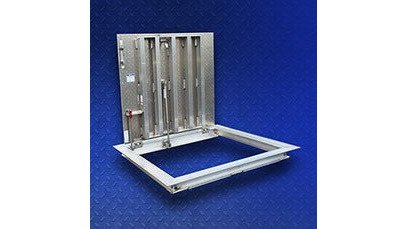
The Halliday Products H1R and H2R series exemplify H-20 rated floor doors designed for vault applications. These angle-frame models are engineered for off-street locations where the door won't face high-density traffic. The single-leaf H1R handles concentrated loads within the H-20 specification, while the double-leaf H2R provides the same load rating across a larger opening.

When you specify an H-20 rated door, you're committing to a specific use case. These doors perform reliably in their intended environment, vaults, mechanical rooms, utility access points in parking areas. Place an H-20 door in a location where forklifts, hand trucks, or rolling equipment will cross it repeatedly, and you're exceeding its design parameters.
Floor Door Load Capacity Standards and Building Code Compliance
Building codes and industry standards define how floor doors must be specified and installed. The load rating must match both the structural design of the building and the actual use case. A floor door over a mechanical vault has different requirements than one providing access to a rooftop or a below-grade utility space.
Load capacity standards account for safety factors, material fatigue, and long-term durability. A floor door rated for H-20 loading includes a safety factor that accounts for variations in installation quality, material properties, and aging. This means the actual structural capacity exceeds the rated load, but only by a defined margin. Exceeding the rated load erodes this safety factor and accelerates material fatigue.
Building codes typically require that floor doors be specified with load ratings appropriate to their location and expected use. A door in a loading dock area needs a higher rating than one in a basement mechanical room. The code also addresses installation tolerances, fastening requirements, and maintenance protocols. Failure to follow these requirements can result in code violations and liability exposure if the door fails.
The structural integrity of the underlying framing members matters equally. A floor door rated for H-20 loading still depends on the joists, beams, and floor structure beneath it to distribute that load safely. If the framing is undersized or damaged, the door will fail regardless of its own rating. Load rating is a system property, the door, the frame, the fasteners, and the supporting structure must all work together.
Pedestrian vs. Vehicular Floor Door Ratings
Pedestrian-rated floor doors are designed for foot traffic and light hand-carrying of materials. These doors are typically rated in pounds per square foot of distributed load. A pedestrian-rated door might handle 200 pounds per square foot, which is sufficient for normal foot traffic and occasional light equipment.
Vehicular-rated doors, like H-20 models, are designed for concentrated wheel loads from vehicles or heavy equipment. The load is no longer distributed across the entire door surface, it's concentrated at specific points where wheels or equipment feet contact the frame. This requires significantly stronger construction: heavier gauge materials, more strong hinges, and stronger fastening systems.
The distinction is critical because the failure modes are different. A pedestrian-rated door under distributed load will show gradual deflection and frame fatigue. A vehicular-rated door under concentrated load will experience localized stress at the contact points. If you install a pedestrian-rated door in a vehicular application, the frame will bend at the wheels, hinges will tear, and the door will become inoperable within weeks.
Halliday Products H2R Aluminum Angle Frame H20 Loading Floor Door/Hatch →
Access frequency also affects the rating choice. A floor door accessed once per month can sometimes tolerate lower ratings than one accessed daily. However, this is not a license to underspecify, building codes and standards exist to prevent failures regardless of use frequency. When in doubt, specify the higher rating. The cost difference between a pedestrian and H-20 rated door is small compared to the cost of an emergency replacement.
Consequences of Incorrect Load Rating Specification
Specifying the wrong load rating creates cascading problems. A floor door rated too low for its actual use will fail prematurely, creating safety hazards and unplanned downtime. A door that fails under load can trap equipment, damage the surrounding structure, or injure personnel if they're nearby.
The structural damage from an overloaded floor door extends beyond the door itself. Repeated loading beyond the rated capacity can damage the underlying floor framing. Joists can crack, fastening points can tear, and the entire floor assembly can be compromised.
Liability exposure is significant. If a floor door fails and causes injury or property damage, the investigation will examine whether the door was rated for its actual use case. If the specification was inadequate, liability falls on whoever selected the door. For contractors, this means potential claims. For facility managers, this means regulatory scrutiny and insurance complications.
Long-term fatigue analysis shows that material failure accelerates dramatically once loads exceed the design rating. A door rated for H-20 can handle occasional loading at that level indefinitely. But sustained or repeated loading above the rating will cause fatigue failure within months, not years. The metal develops micro-cracks, hinges loosen, and fasteners fail. By the time the door becomes visibly damaged, structural failure is already underway.
How to Specify the Right Load Rating for Your Project
Start with the actual use case. What will cross this floor door? Is it foot traffic only, or will equipment roll across it? Will the door see occasional loading or daily use? Will the loads be distributed or concentrated?
Document the equipment that will use the space. If forklifts will operate in the area, note their weight and wheel configuration. If hand trucks will be common, note their typical load.
Consult the building code for your jurisdiction and the structural engineer for the project. The engineer can verify that the floor framing can support the loads you're planning to apply.
Match the door specification to the load rating requirement. Halliday Products H1W and H2W channel-frame models with H-20 rating are suitable for vaults and off-street applications where water management is important.

Request the manufacturer's specification sheet and installation documentation for any floor door you're considering. The sheet will state the load rating, the installation requirements, the fastening specifications, and any limitations on use.
| Selection Criterion | Pedestrian-Rated Doors | H-20 Rated Doors |
|---|---|---|
| Typical Load Range | 150-250 lbs/sq ft | 16,000 lbs concentrated per wheel |
| Best Application | Basements, utility vaults, light-traffic areas | Off-street vaults, mechanical rooms, occasional vehicle access |
| Installation Complexity | Standard fastening | Reinforced framing required |
| Long-term Durability | 10-15 years with appropriate use | |
| Cost Consideration | Lower initial cost | Higher initial cost, lower lifetime cost if properly specified |
Verify that the installation crew understands the load rating and the installation requirements. An improperly installed floor door, with inadequate fastening, misaligned frame, or insufficient support, will fail prematurely regardless of its rated capacity.
After installation, document the load rating in the building's maintenance records. Future facility managers need to know what the door can handle.
Getting the load rating right for your floor doors means understanding the difference between pedestrian and vehicular applications, respecting the structural limits of the door assembly, and matching the specification to the actual use case.
Frequently Asked Questions
What does H-20 load rating mean for a floor door?
H-20 is a standard load rating indicating the floor door can safely support a concentrated load of 20,000 pounds applied over a 20-inch by 20-inch area. This rating is used for off-street locations such as utility vaults near roadways but not in active traffic zones. The H-20 designation comes from AASHTO (American Association of State Highway and Transportation Officials) standards and is commonly referenced in construction specifications for access doors and hatches.
What happens if I install a floor door without the correct load rating?
Installing an undersized load-rated floor door creates multiple risks: structural failure under expected loads, hinge stress and frame rigidity collapse, safety hazards for personnel accessing the space, potential liability and code violations, and costly emergency repairs or replacements. A door rated for pedestrian-only traffic cannot handle equipment or vehicle loads. Conversely, over-specifying adds unnecessary cost. Matching load rating to actual use prevents mechanical failure and ensures compliance with building codes and OSHA requirements.
How do I determine the required load rating for my specific application?
Start by identifying what will access the floor door: pedestrians only, wheeled equipment, or vehicles. Calculate the maximum concentrated load (weight of heaviest single item) and distributed weight (total weight spread across the door). Consider access frequency and environmental factors like corrosion exposure. Cross-reference your findings against building codes and OSHA standards for your jurisdiction. For commercial applications, consult with structural engineers if load calculations are complex. Halliday Products floor doors like the H-20 rated models work for utility vaults and off-street locations where equipment access is occasional and controlled.
What is the difference between uniform load and concentrated load for floor doors?
Uniform load spreads weight evenly across the entire door surface, such as stacked materials or foot traffic. Concentrated load applies weight to a small area, like the wheel of a forklift or a single piece of heavy equipment. Floor doors must handle both scenarios, but concentrated loads create higher stress on hinges, framing members, and anchoring systems. Load ratings like H-20 are based on concentrated load testing, so they define the maximum point load the door can safely support. Understanding this distinction ensures you select doors that match your actual equipment and usage patterns.