
Table of Contents
- Spring-Assisted vs Manual Roof Hatches: Key Differences
- Comparison Table: Spring-Assisted and Manual Options
- Manual Operation and Opening Mechanisms
- Benefits of Gas Spring Technology
- OSHA Roof Hatch Safety Requirements and Compliance
- Roof Hatch Maintenance Checklist and Spring Assembly Care
- Gas Spring Replacement for Roof Hatches: Timing and Process
- Cost-Benefit Analysis and Long-Term Operational Costs
- Frequently Asked Questions
Last Updated: September 28, 2026
Spring-Assisted vs Manual Roof Hatches: Key Differences
When evaluating spring assisted vs manual roof hatches, the choice directly impacts labor costs, safety compliance, and maintenance expenses. Victory Construction Products has helped contractors and facility managers navigate this decision for over 27 years.
Spring-assisted roof hatches use gas springs to counterbalance the lid's weight, reducing opening force. Manual hatches rely entirely on user strength, creating exposure to worker fatigue and injury risk.
Comparison Table: Spring-Assisted and Manual Options
| Feature | Manual Roof Hatches | Spring-Assisted Roof Hatches |
|---|---|---|
| Opening Force Required | 40-60 lbs | 8-15 lbs |
| One-Hand Operation | No | Yes |
| Initial Cost | Lower ($757-$966) | Higher ($925-$1,340) |
| Spring Replacement Needed | No | Every 8-12 years |
| Worker Safety Rating | Moderate | High |
| Best For | Budget-conscious, light-use facilities | High-traffic roofs, aging staff, compliance-focused facilities |
| Installation Complexity | Simple | Moderate |
| Maintenance Burden | Minimal | Regular spring checks |
Manual hatches from Victory Construction Products start at $757 for the Dur-Red model, while spring-assisted options range from $925 (JL Industries) to $1,340 (Elmdor). The price difference becomes irrelevant once you calculate labor savings and injury prevention over a 15-year lifespan.

Manual Operation and Opening Mechanisms
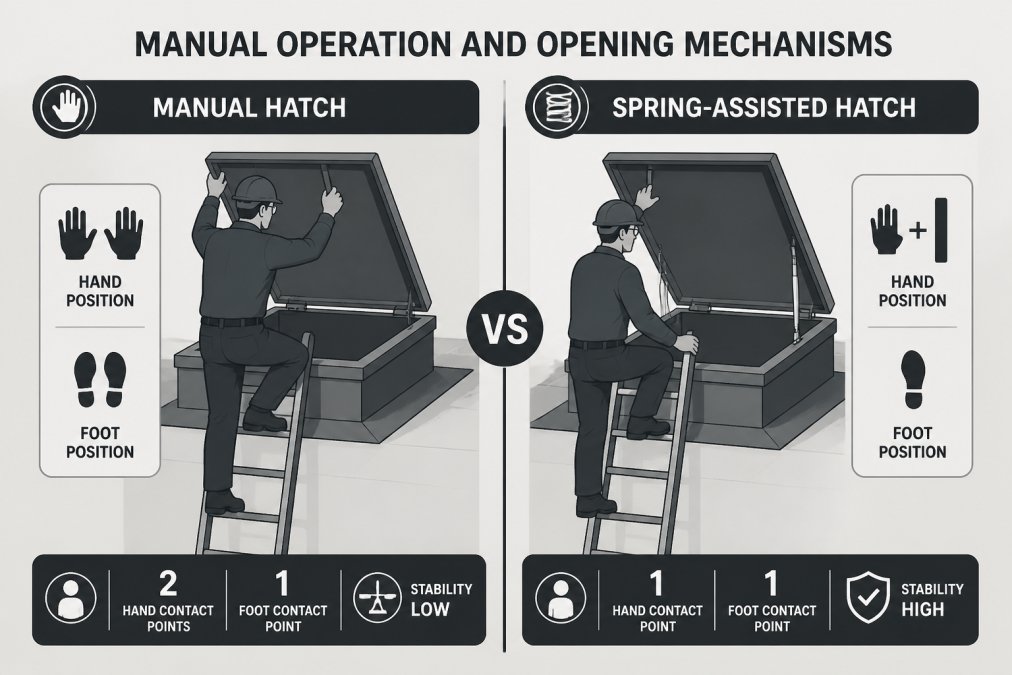
Manual hatches require two-handed operation, forcing workers to release their grip on the ladder. Most injuries occur when workers lose balance or drop the hatch while managing its weight.
Understanding Force Requirements and User Strength Thresholds
A standard manual hatch requires 40-60 pounds of opening force, the effort needed to break it free from its closed position.
A hatch requiring 50+ pounds of force exceeds safe limits for many workers:
- Average adult male (150-180 lbs): Can safely operate 40-60 lb hatches with proper technique
- Average adult female (130-160 lbs): Often struggles with hatches requiring more than 35-40 lbs of force
- Workers over 55 years old: Experience 15-25% reduction in grip strength and lifting capacity
- Workers with arthritis, carpal tunnel, or shoulder injuries: May be unable to operate manual hatches safely at all
Facility managers report staff avoid roof access with manual hatches.
The Three-Point Contact Problem
Manual hatches force workers to release one hand to operate the hatch, breaking three-point contact during the critical transition from ladder to roof.
Slip, trip, and fall incidents account for a significant portion of roof access injuries, many occurring during hatch operation when workers are unbalanced.
When Manual Hatches Make Sense
Manual hatches offer simplicity: no springs to fail, no seals to degrade, no scheduled replacements. For buildings with minimal roof access needs, manual operation keeps initial costs low. The Dur-Red Roof Hatch ($757) and Acudor Roof Hatch ($966) exemplify this approach.

Manual hatches suit facilities where all users are young, fit, and trained in proper lifting technique. Some industrial facilities choose manual hatches as a deterrent to unauthorized access.
In high-traffic environments or facilities with diverse workforces, manual hatches create problems. Workers skip maintenance tasks or rush procedures due to fatigue. For these facilities, the strength requirement becomes a liability.
Benefits of Gas Spring Technology
Spring-assisted hatches reduce opening force, improving safety, compliance, and operational frequency.
Spring-assisted hatches enable consistent access for all workers regardless of age or strength. A 65-year-old supervisor can operate the hatch as easily as a 25-year-old contractor.
Spring-assisted systems provide smooth deceleration, preventing sudden drops and protecting equipment and personnel. Bilco ($1,150) and Elmdor ($1,340) models incorporate controlled descent as standard.

OSHA requires roof access equipment not create undue hazards. Spring-assisted hatches directly address this by reducing force.
One-hand operation allows workers to maintain ladder contact throughout access, reducing slip and fall incidents more effectively than training alone.
OSHA Roof Hatch Safety Requirements and Compliance
OSHA requires roof access systems not create unnecessary hazards and be maintained safely, but doesn't mandate hatch type. Spring-assisted systems increasingly align with this requirement because they demonstrably reduce injury risk.
Manual hatches force workers to break contact; spring-assisted hatches allow workers to maintain ladder contact.
Facility managers should document maintenance records, including spring inspections and force-reduction testing, to demonstrate due diligence. Annual force-measurement audits verify spring-assisted hatches operate within safe parameters.
Check local requirements, as some jurisdictions now prefer or require spring-assisted systems for new construction.
Roof Hatch Maintenance Checklist and Spring Assembly Care
Manual hatches require minimal maintenance. Spring-assisted systems demand more attention because gas springs degrade over time. Understanding degradation factors helps facility managers plan replacements and avoid downtime.
Spring Assembly Maintenance Schedule
- Monthly: Visually inspect springs for visible corrosion or leaks (gas springs may weep slightly, which is normal; significant fluid loss indicates failure)
- Quarterly: Test opening force by hand; it should feel consistent with previous tests
- Annually: Clean spring seals and hinge areas; apply light machine oil to hinge pins
- Every 3 years: Have a qualified technician measure opening force with a calibrated scale; document the reading
- Every 8-12 years: Plan for spring replacement before failure occurs
Environmental Impact on Spring Performance and Lifespan
Gas springs are sensitive to temperature extremes, the most overlooked factor in spring failure. Gas expands and contracts with temperature, directly affecting force.
- Cold climates: Springs lose 3-5% force per 10°F drop. A 12-pound spring at 70°F provides only 8-9 pounds at 0°F.
- Hot climates: Springs above 100°F lose 20-30% lifespan and may need replacement every 6-8 years instead of 10-12.
- Coastal environments: Salt spray accelerates corrosion. Facilities within 5 miles of saltwater should inspect springs every 6 months.
- Freeze-thaw cycles: Repeated expansion and contraction accelerates seal wear.
Facility managers in extreme climates should plan spring replacement on a shorter cycle, acknowledging environmental stress.
Predicting Spring Failure and Remaining Lifespan
Spring degradation follows a predictable curve. Springs should be replaced periodically regardless of measured force.
Skipping annual inspections risks discovering failed springs only when workers report difficulty, at which point failure may occur during the next opening cycle.
Quantifying Spring Degradation: The Force Measurement Protocol
Calibrated force measurement is a reliable way to predict spring life. Hand estimates are insufficient; springs degrade in ways that feel gradual but are measurable with precision instruments.
A technician uses a calibrated scale to measure opening force, recorded annually.
This data-driven approach allows facility managers to budget for spring replacement on a predictable schedule rather than responding to emergencies.
Comparing Maintenance Burden: Springs vs. Manual Hinges
Annual spring inspections are recommended.
Manual hatches require less frequent inspection but may require more intensive repairs.
Spring Replacement: Timing and Process
Gas Spring Replacement for Roof Hatches: Timing and Process
Knowing when to replace springs prevents the sudden loss of assistance that creates safety hazards. Most gas springs operate for a number of years under normal use, though this varies based on climate, frequency of operation, and maintenance quality.
Warning signs that springs need replacement:
- Opening force increases noticeably (workers mention the hatch "feels heavier")
- The hatch no longer holds open position; it drifts closed slowly
- Springs show visible corrosion, pitting, or surface rust
- A calibrated force test shows opening force exceeds 25 pounds
Cost-Benefit Analysis and Long-Term Operational Costs
The initial price difference between manual and spring-assisted hatches appears significant, but this analysis ignores the true cost of operation over time.
Manual Hatch Total Cost of Ownership (15 years):
- Initial purchase: $800 (average)
- Hinge maintenance and lubrication: $50/year = $750
- Replacement hinges (typically needed once): $200
- Lost productivity from workers avoiding access: $2,000-$5,000 annually
- Potential injury claims (industry average): $40,000-$80,000
- Total: $44,000-$86,500
Spring-Assisted Hatch Total Cost of Ownership (15 years):
- Initial purchase: $1,100 (average)
- Annual spring inspection and maintenance: $100/year = $1,500
- Spring replacement (one cycle, typically year 10): $250
- Reduced lost productivity (workers access roof more frequently): $500-$1,000 annually
- Injury prevention savings: $35,000-$70,000
- Total: $38,250-$73,750
Frequently Asked Questions
What are the main differences between spring-assisted and manual roof hatches?
Spring-assisted roof hatches use gas springs to reduce the force needed to open the hatch, allowing easier operation with less physical effort. Manual roof hatches require full hand strength to lift and hold open. Spring-assisted models typically cost more upfront but reduce strain on users and can improve safety by keeping one hand free on the ladder. Manual hatches are more affordable initially but demand greater physical effort and pose ergonomic risks during frequent access.
What are the OSHA roof hatch safety requirements for commercial buildings?
OSHA requires roof hatches to provide safe access with secure opening mechanisms. The hatch opening mechanism must be operable from inside the building, and the structure must safely support worker weight. Spring-assisted hatches that reduce operational effort can help meet safety standards by minimizing the risk of falls caused by loss of balance during manual operation.
How often should I perform maintenance on a roof hatch with gas springs?
Inspect your roof hatch regularly for signs of corrosion, hinge damage, and spring performance. Check the seal for weatherproofing integrity and test the opening mechanism to ensure smooth operation. Clean debris from hinges and springs periodically. Gas springs have a lifespan that depends on climate and usage frequency. Include spring assembly inspection in your roof hatch maintenance checklist to catch wear before springs fail completely, which can make the hatch suddenly heavy and difficult to operate safely.
When is it time to replace the gas springs in a roof hatch?
Replace gas springs when the hatch becomes noticeably harder to open, springs lose pressure, or you notice oil leaks from the spring cylinders. If the hatch no longer stays open without manual support or slams shut unexpectedly, spring replacement is urgent. Gas spring replacement for roof hatches varies in cost depending on the hatch model. Most commercial buildings should plan for periodic replacement as part of preventative maintenance. Delaying replacement increases injury risk and can damage hinges and the hatch frame.
Are manual roof hatches still compliant with modern safety standards?
Yes, manual roof hatches can meet current safety standards if they include proper locking mechanisms, secure hinges, and weatherproof seals. Manual hatches comply with codes but may require additional fall protection measures during operation. Spring-assisted alternatives are becoming preferred in new construction because they reduce the physical demands on workers and lower injury risk, making them the safer long-term choice for facilities with frequent roof access.