
Table of Contents
- What Procurement Strategies for Construction Hardware Actually Mean
- Construction Hardware Cost Reduction Strategies That Work
- Strategic Sourcing and Vendor Qualification
- Construction Supply Chain Management for Hardware
- Procurement Risk Management in Construction
- Technology and Procurement Automation
- Implementation Roadmap for Your Hardware Procurement Strategy
- Frequently Asked Questions
Last Updated: September 19, 2026
What Procurement Strategies for Construction Hardware Actually Mean
Procurement strategies for construction hardware are the systematic approaches you use to source, purchase, and manage the materials and equipment your projects depend on. This isn't just about finding the lowest price, it's about balancing cost, quality, delivery speed, and supplier reliability to keep projects on schedule and within budget.
At Victory Construction Products, we've spent over 27 years watching contractors and facility managers struggle with fragmented supply chains. The ones who succeed treat procurement as a strategic function, not a transactional one. They forecast demand, qualify vendors carefully, negotiate terms upfront, and build redundancy into their supply network so a single delay doesn't cascade into project failure.
The difference between reactive procurement and strategic procurement shows up immediately in project timelines. When you're scrambling to source a fire-rated access door three days before installation, you're paying premium pricing and hoping the supplier has stock. When you've planned six weeks out, you control the conversation. You can compare options, negotiate volume discounts, and confirm delivery windows before committing.

Strategic procurement strategies for construction hardware also protect you against supply chain volatility. Material availability fluctuates. Lead times shift. Prices move. A solid procurement strategy includes contingency suppliers, inventory buffers for critical items, and relationships deep enough that your vendor calls you with advance notice when shortages are coming, not the other way around.
Construction Hardware Cost Reduction Strategies That Work
Cost reduction in hardware procurement isn't about squeezing vendors until they break. It's about removing waste from your procurement process and using your buying power intelligently.
Start with visibility into what you actually buy. Many contractors discover they're purchasing the same roof hatch from three different suppliers at three different prices. Consolidate spending with fewer vendors, and you immediately gain negotiating use. A vendor who sees $50,000 in annual volume from you will negotiate harder than one seeing $5,000 scattered across sporadic orders.
Bulk purchasing is one of the most underutilized cost levers. If you manage multiple properties or run concurrent projects, aggregate your hardware needs across all of them. Order 20 access doors at once instead of four at five different times. The per-unit cost difference is substantial. Victory Construction Products stocks 15 trusted brands in 11 warehouse locations specifically to handle volume orders without delay, same-day shipping on most in-stock items means bulk purchasing doesn't force you to wait weeks for delivery.
Standardization reduces cost and complexity. If your specifications call for 12 different roof hatch models across your portfolio, you're managing 12 separate supply chains. Standardize on three or four models that meet your needs across different applications. You'll negotiate better pricing, reduce training burden on installation crews, and simplify maintenance and replacement parts inventory.
Lead time optimization also cuts costs. Rush delivery fees are real. If you order with 48 hours' notice, you pay for expedited shipping. If you order with four weeks' notice, standard shipping costs 30-40% less. Building forecasting into your procurement strategy, understanding when projects need materials and ordering accordingly, removes the urgency premium.
Strategic Sourcing and Vendor Qualification
Strategic sourcing starts with knowing what you need and who can supply it reliably. Vendor qualification is the process of evaluating potential suppliers against criteria that matter to your business: product quality, pricing consistency, delivery reliability, technical support, and financial stability.
Don't evaluate vendors on price alone. A supplier offering the lowest bid might have inconsistent quality, unreliable delivery, or weak technical support. When a fire-rated access door fails inspection because it doesn't meet specification, the cost of rework far exceeds any savings from the cheaper initial purchase. Evaluate vendors across multiple dimensions: Do they carry the brands you specify? Can they provide submittals and spec sheets quickly? Do they stock inventory or drop-ship everything? What's their actual track record on on-time delivery?
Reference checks matter. Ask vendors for three customer references from contractors or facility managers similar to your operation. Call them. Ask about delivery reliability, responsiveness to issues, and whether the vendor actually stocks what they claim to stock. You'll get honest answers about whether a vendor is worth your business.
Contractual frameworks establish expectations upfront. Define payment terms, delivery windows, quality standards, and what happens if the vendor misses commitments. A vendor who knows you'll hold them accountable for delivery dates performs differently than one with no consequences. Include language about pricing adjustments if market conditions change dramatically, this protects both parties during supply chain volatility.
Supplier relationship management is ongoing, not transactional. Meet with key vendors quarterly. Share your project pipeline so they can plan inventory. Give them feedback on performance. The vendors who understand your business and priorities will flag issues before they become problems. They'll alert you when lead times are extending on specific products. They'll work with you on custom configurations or expedited orders when you genuinely need them.
Construction Supply Chain Management for Hardware
Your supply chain for hardware procurement includes everything from initial forecasting through installation and warranty support. Effective supply chain management prevents bottlenecks and keeps projects moving.
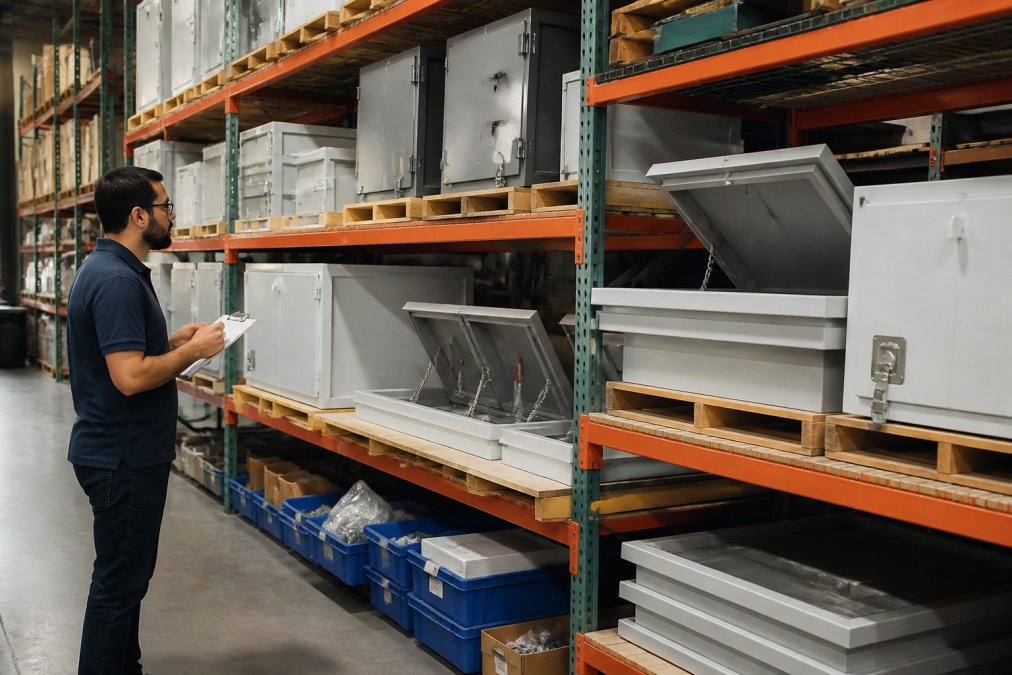
Forecasting accuracy drives everything downstream. If you manage 50 commercial properties across three states, you need visibility into what maintenance and upgrade projects are scheduled across your portfolio. This isn't complex, it's a spreadsheet listing projects, timelines, and required hardware. Share this forecast with your suppliers three to six months out. They can plan inventory accordingly. You can negotiate volume pricing. Everyone wins.
Access Door – JL Industries FD – Fire →
Inventory turnover matters. Holding excessive inventory ties up capital and risks obsolescence. Not holding enough inventory creates project delays and forces expensive expedited orders. The balance depends on your business model. A contractor managing time-sensitive commercial projects might maintain higher inventory of fast-moving items like fire-rated access doors. A facility manager overseeing planned maintenance can operate with leaner inventory because projects are scheduled further out.
Lead time optimization across your entire supply chain prevents cascading delays. If your installation crew needs a roof hatch and the supplier has a two-week lead time, that two weeks delays your entire project. Victory Construction Products maintains same-day shipping on most in-stock orders specifically because we understand that hardware delivery directly impacts project schedules. When you're sourcing from a distributor with stocking warehouses in 11 states, you're not waiting weeks for drop-shipped items to arrive.
Logistics coordination connects suppliers to job sites efficiently. Document where materials need to go, when they need to arrive, and who's receiving them. Communicate this clearly to your supplier. A simple detail, the difference between shipping to the project address versus a central warehouse, affects your receiving burden and project flow.
Procurement Risk Management in Construction
Risk in hardware procurement comes from supply disruptions, quality failures, and price volatility. Managing these risks prevents project delays and budget overruns.
Supply chain disruption is real. A supplier goes out of business. A manufacturer experiences a production delay. A natural disaster impacts a distribution hub. Single-sourcing critical hardware creates vulnerability. Maintain relationships with at least two qualified suppliers for items that are mission-critical to your projects. The cost of maintaining backup supplier relationships is trivial compared to the cost of a project shutdown because your only source for fire-rated access doors is suddenly unavailable.
Quality assurance protects you from expensive rework. Establish clear specifications for every hardware item you purchase. Require submittals before purchase confirming the exact product meets your specs. When items arrive, inspect them before installation. A fire-rated access door that doesn't meet specification creates liability and delays. Catching the issue at receiving is far cheaper than catching it during inspection.
Price volatility requires contractual protection. Long-term supply agreements with price caps or escalation clauses protect you against sudden cost spikes. If material costs surge 20% mid-project, a contract with a capped escalation clause limits your exposure. Conversely, if you're locking in prices for 12 months of supply, the vendor needs reasonable protection against dramatic cost decreases.
Financial stability of your suppliers matters more than you might think. A vendor offering aggressive pricing might be financially unstable. If they go out of business mid-project, you're scrambling for replacement supply. Check vendor financial health before committing to major purchase agreements. Ask about their ownership, financial backing, and business trajectory.
Technology and Procurement Automation
Construction procurement software simplifies the entire process from forecasting through payment. The right tools reduce manual work, improve visibility, and catch errors before they become expensive.
Digital procurement platforms give you centralized access to product specifications, pricing, availability, and submittals.
Implementation Roadmap for Your Hardware Procurement Strategy
Building a strategic procurement strategy for construction hardware doesn't happen overnight. Start with the fundamentals and build from there.
Frequently Asked Questions
What are the most effective procurement strategies for construction hardware?
The most effective approaches combine strategic sourcing (qualifying vendors based on quality and reliability), bulk purchasing to reduce unit costs, lead time optimization to prevent delays, and inventory management integration to balance stock levels with project timelines. Centralized procurement through a single distributor with multiple warehouse locations, like Victory Construction Products with 11 stocking warehouses, eliminates fragmented ordering and speeds up delivery for time-sensitive projects. Pairing these with procurement automation software reduces manual errors and improves forecasting accuracy.
How can construction firms mitigate supply chain risks for hardware components?
Procurement risk management in construction requires diversifying suppliers while maintaining relationships with reliable partners, establishing contractual frameworks that include penalty clauses for missed deliveries, and building buffer inventory for critical items like fire-rated access doors. Monitor lead time volatility and inflation trends to adjust purchasing timing. Implement vendor qualification processes that assess financial stability, compliance certifications, and past performance. Working with distributors offering same-day shipping on in-stock orders reduces dependency on long lead times and shields projects from supply chain disruptions.
What is the difference between transactional and strategic procurement in construction?
Transactional procurement focuses on individual purchases at the lowest immediate price, treating each order as a one-off transaction. Strategic procurement builds long-term relationships with vendors, negotiates volume discounts, aligns purchasing with project lifecycle timelines, and considers total cost of ownership, not just unit price. Strategic sourcing reduces administrative overhead, improves quality assurance, and enables better forecasting. For construction hardware, strategic procurement means partnering with a distributor offering lowest-price guarantees, easy access to model numbers and submittals, and reliable inventory across multiple locations.
How does centralized procurement improve construction project efficiency?
Centralized procurement consolidates orders through one distributor, eliminating duplicate efforts across teams and projects. This approach improves stakeholder alignment, reduces lead time variability, and strengthens vendor relationships for better pricing and service. A single procurement software system provides real-time visibility into inventory, pricing, and delivery status. For facility managers overseeing 50 properties across multiple states, centralized procurement through a distributor with 11 warehouses ensures consistent supply, faster fulfillment, and simplified compliance tracking across all locations.