
Table of Contents
- Top Fire-Rated Access Doors: Quick Comparison
- Understanding Fire-Rated Access Door Building Codes
- Fire-Rated Access Door Installation Requirements
- How to Choose Fire-Rated Access Doors
- Top Fire-Rated Access Door Products for 2026
- Installation Best Practices and Common Mistakes
- Retrofitting vs. New Construction Considerations
- Conclusion
Last Updated: August 26, 2026
Top Fire-Rated Access Doors: Quick Comparison
Fire-rated access doors are a code requirement that directly affects liability, safety compliance, and project timelines. The best options balance UL certification, temperature rise protection, and installation flexibility without forcing you to choose between compliance and budget.
This guide from Victory Construction Products covers the fire-rated access doors that matter most to contractors, facility managers, and procurement teams across wall and ceiling assemblies, fire rating durations, and real-world installation scenarios.
| Product | Fire Rating | Best For | Starting Price |
|---|---|---|---|
| Acudor FW-5050 | 1.5 hrs (wall), 3 hrs (ceiling) | Walls with temperature rise concerns | $189.00 |
| Milcor UFR | 1.5 hrs (wall), 2-3 hrs (ceiling) | Premium temperature protection | $240.00 |
| Elmdor FRC | 1.5 hrs (wall), 3 hrs (ceiling) | Dual-rated walls and ceilings | $110.00 |
| Cendrex PFU | 3 hrs (ceiling only) | Gravity-closing ceiling access | $430.00 |
| Acudor FB-5060 | 1.5 hrs (wall), 2 hrs (wall) | Cost-effective wall installations | $136.00 |
Understanding Fire-Rated Access Door Building Codes
Fire-rated access doors are regulated by the International Building Code (IBC) and enforced through Underwriters Laboratories (UL) certification standards. Your local building department references these codes during inspection, so understanding baseline requirements prevents costly rework and delays.

A fire-rated access door maintains the integrity of a fire-rated wall or ceiling assembly by containing heat and preventing flame penetration for a specified duration, typically 1.5, 2, or 3 hours. Building codes require fire-rated access doors in any penetration of a fire-rated wall or ceiling that provides access to mechanical, electrical, or plumbing systems. Non-compliance results in failed inspections, fines, and liability exposure.
UL certification is the enforcement mechanism. A UL-listed door confirms the product has passed standardized fire tests and meets ANSI-UL 10B standards. Temperature rise is a secondary but critical requirement in walls. Many codes require that the unexposed side of a fire-rated wall assembly not exceed a 250-degree temperature rise after 30 minutes of fire exposure (iccsafe.org). Insulated models like the Milcor UFR and Acudor FW-5050 meet this requirement.

Fire-Rated Access Door Installation Requirements
A properly certified door becomes useless if installation compromises the fire rating of the surrounding assembly.
Wall vs. Ceiling Assembly Requirements
Wall and ceiling installations have fundamentally different requirements because fire behavior differs between orientations.
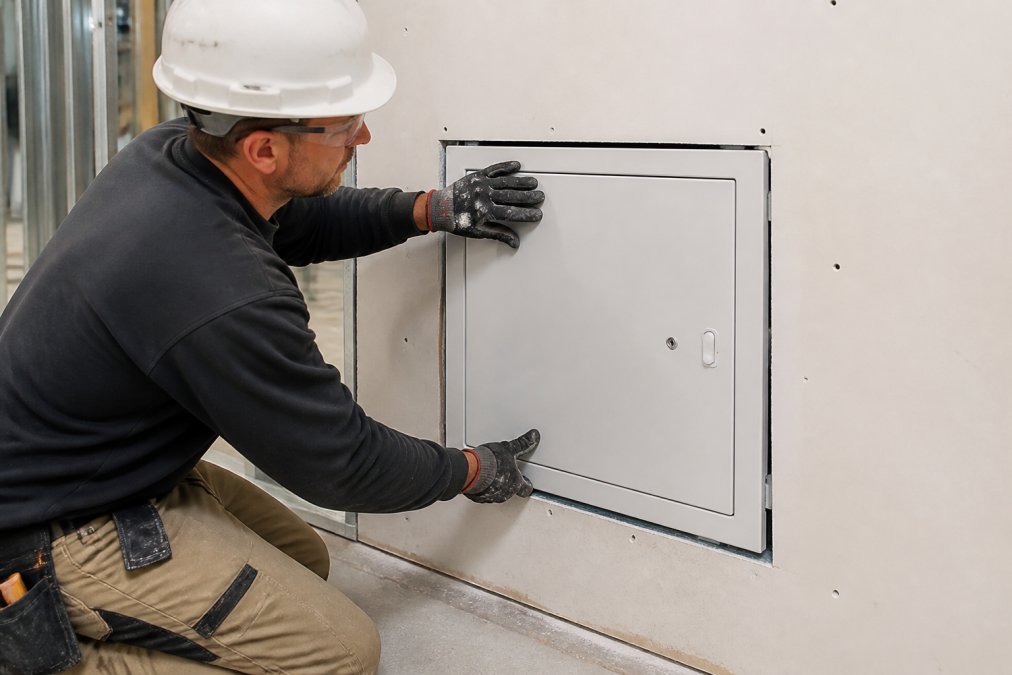
For walls, the access door frame must be set flush with the finished surface or recessed into the cavity. The frame flange, typically 16-gauge steel, anchors to wall framing, and surrounding drywall is finished around it.
Ceiling installations are more restrictive. Fire-rated ceilings require the door to remain closed under fire conditions. Self-closing mechanisms are mandatory, and the door must not exceed 89 degrees of opening angle to prevent smoke and flame penetration (iccsafe.org). Gravity-closing models like the Cendrex PFU are designed for this requirement. Ceiling doors are limited to smaller dimensions, typically 24" x 36" maximum.
Insulation and Material Standards
Mineral wool insulation is the standard for fire-rated doors. It's non-combustible, maintains its properties at high temperatures, and provides consistent thermal resistance. The Milcor UFR and Acudor FW-5050 both use mineral wool insulation to limit temperature rise to 250 degrees Fahrenheit after 30 minutes.
Most fire-rated doors use 16-gauge or 18-gauge steel frames and panels. Fire-rated doors use intumescent gaskets that expand when exposed to heat, sealing gaps and preventing smoke penetration without mechanical intervention.
How to Choose Fire-Rated Access Doors
Selecting the right fire-rated access door depends on three factors: the fire rating required by code, whether temperature rise protection is needed, and whether you're installing in a wall or ceiling.
Start with your building code requirement. Pull the architectural plans and fire-rating schedule to determine what rating is required at each location. Next, determine if temperature rise is required. If your code requires limiting heat transfer through the assembly, you need an insulated door. Then assess installation location, wall doors and ceiling doors are not interchangeable. Finally, consider budget constraints.
Fire Rating Durations: 1-Hour, 2-Hour, and 3-Hour Options
A 1.5-hour fire rating is the most common requirement for commercial buildings, satisfying the International Building Code for most wall and ceiling separations. The Acudor FB-5060, Elmdor FR, and Elmdor FRC all provide 1.5-hour ratings in walls at lower price points.

A 2-hour fire rating is required for higher-risk occupancies and certain use group separations. The Milcor UFR and Acudor FW-5050 both achieve 2-hour ratings in walls. Ceiling applications often require 2-hour or 3-hour ratings because fire travels upward through ceiling cavities more easily than horizontally through walls.
A 3-hour fire rating is required in shaft enclosures, stairwell separations, and certain high-hazard occupancies. The Acudor FW-5050 achieves 3-hour ratings in ceilings (maximum 24" x 36"), and the Cendrex PFU also provides 3-hour ceiling ratings.
UL Approval and Compliance Standards
UL approval is not optional; it's the enforcement mechanism for fire-rated access doors in commercial construction. Every fire-rated door must carry a UL label or equivalent certification (ULC for Canadian projects, Warnock Hersey for certain applications).
The UL label includes specific information: the fire rating, rating type (wall, ceiling, or both), maximum temperature rise if applicable, and maximum door size. This information must match your project specifications exactly. According to UL's fire safety standards for access doors, doors must pass standardized fire endurance tests where the assembly is exposed to a time-temperature curve that simulates real fire conditions.
When ordering from Victory Construction Products, every product listing includes the UL rating and specifications, making it easy to verify that what you're ordering matches your project requirements.
Top Fire-Rated Access Door Products for 2026
1. Acudor FW-5050: Insulated Wall and Ceiling Option
The Acudor FW-5050 is the most versatile fire-rated access door for mixed applications. In walls, it provides 1.5-hour UL and ULC certification with 250-degree temperature rise protection. In ceilings, it achieves 3-hour Warnock Hersey approval (maximum 24" x 36"), making it suitable for high-fire-rating applications.
The mineral wool insulation provides temperature rise protection required in walls. The self-closing mechanism uses a coil spring that dampens the door's closing action while ensuring reliable latching. The drywall flange option (FB-5050-DW variant) simplifies installation by eliminating the need for additional trim.
Dual-rating capability means you can stock one product for both wall and ceiling penetrations. At $189.00, it costs more than non-insulated alternatives, and the 3-hour ceiling rating is limited to 24" x 36".
2. Milcor UFR: Premium Temperature Rise Protection
The Milcor UFR is engineered specifically for applications where temperature rise is the limiting factor. It carries 1.5-hour UL and CUL certification in walls with 250-degree temperature rise protection, and achieves 2-hour wall ratings and 3-hour ceiling ratings under Warnock Hersey certification.
The insulation is optimized for thermal performance, limiting temperature rise to 250 degrees Fahrenheit after 30 minutes. The automatic panel closer uses a strong coil spring for self-closing and self-latching performance. The snap latch can be left locked or unlocked without affecting the closer seal.
Superior temperature rise protection and insulated sandwich-panel design reduce sound transmission. At $240.00, it's the most expensive option. If temperature rise protection isn't required by code, you're paying for an unnecessary feature.
3. Elmdor FRC: Dual-Rated Walls and Ceilings
The Elmdor FRC delivers 1.5-hour UL ratings in walls and 3-hour Warnock Hersey ratings in ceilings at $110.00, making it the best value for projects requiring both wall and ceiling fire-rated access. It's not insulated, so it doesn't provide temperature rise protection, but it meets code in applications where temperature control isn't specified.
Heavy-duty spring closures ensure positive latching when the panel closes. An interior latch release is included on all doors, allowing personnel to unlock the door from inside, a safety feature that prevents people from being trapped if the exterior latch fails.
Exceptional price-to-performance ratio and dual-rated capability at the lowest price point among comparable products. No temperature rise protection means it fails code in applications requiring heat transfer limits.
4. Cendrex PFU: Gravity-Closing Ceiling Access
The Cendrex PFU is designed exclusively for fire-rated ceiling applications. Unlike spring-loaded models, it uses gravity to close and lock the door, the panel falls back into its locked position by physics, not mechanical springs. This design eliminates spring failure risk and simplifies maintenance.
The door opening angle is limited to 89 degrees maximum, a code requirement for fire-rated ceilings. Maximum size is 24" x 36", and it achieves 3-hour fire ratings under Warnock Hersey certification.
Gravity-closing mechanism is inherently more reliable with fewer moving parts and no spring maintenance required. At $430.00, it's significantly more expensive than wall alternatives, and the 24" x 36" size limitation means larger ceiling penetrations require different solutions.
5. Acudor FB-5060: Cost-Effective Wall Installation
The Acudor FB-5060 provides 1.5-hour UL certification and 2-hour ULC certification in walls without insulation. It's designed to maintain continuity in a 2-hour fire barrier wall when temperature rise is not a factor.
At $136.00, it's one of the lowest-priced UL-certified fire-rated doors available. The drywall taping bead flange option (FB-5060-DW) simplifies installation by providing a finished edge that integrates with drywall finishing.
Lowest price point for UL-certified fire-rated wall doors. Wall-only application limits flexibility, and there's no temperature rise protection or ceiling rating option.
Installation Best Practices and Common Mistakes
Installing fire-rated access doors correctly prevents costly rework. The door itself is only half the equation; installation determines whether the fire rating is maintained.
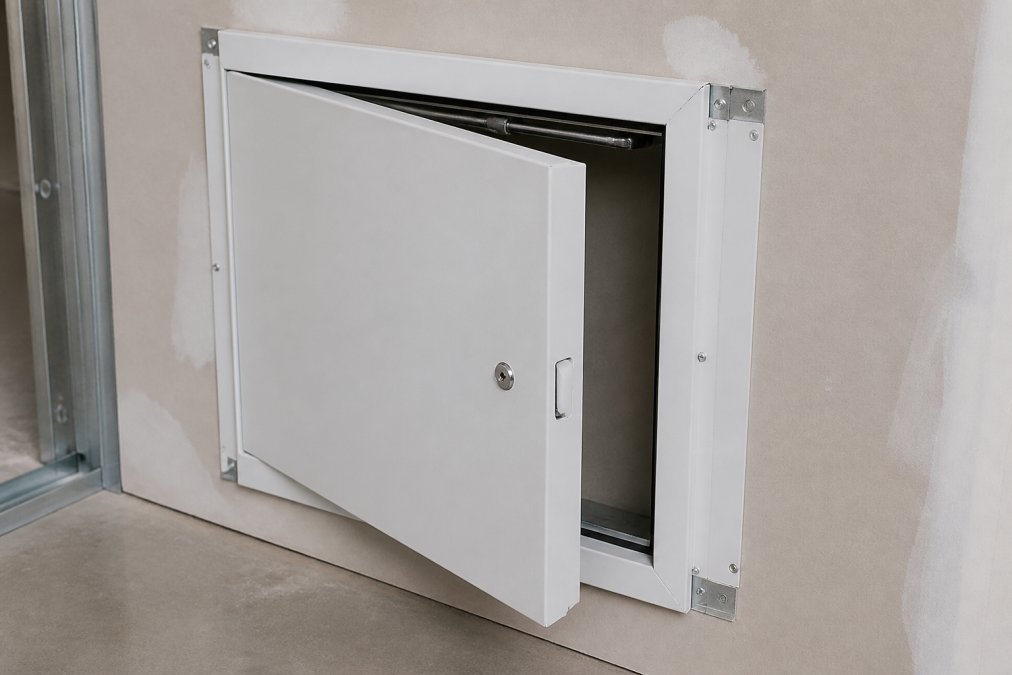
The most common mistakes are undersizing the rough opening, installing the wrong door in the wrong location (wall doors in ceilings or vice versa), improper frame anchoring to framing rather than drywall, failing to maintain the fire rating around the frame with fire-stop sealant or mineral wool insulation, and not testing the self-closing mechanism before project completion.
Retrofitting vs. New Construction Considerations
Retrofitting fire-rated access doors into existing buildings presents different challenges than new construction.
In new construction, the rough opening is framed to exact specifications before drywall is hung. The frame is installed, fire-stop material is applied, and drywall is finished around the flange. This is the cleanest, most cost-effective installation.
Retrofitting requires removing the old door and frame, which often means cutting through finished drywall or other materials. If the existing opening is smaller than the new fire-rated door requires, you'll need to enlarge the opening, potentially affecting structural framing. The key consideration is whether the existing opening is in a fire-rated assembly. If it is, you must maintain the fire rating during retrofit using fire-stop materials around the new frame.
For retrofits, consider whether you need to maintain occupancy during the work. Victory Construction Products' same-day shipping capability helps minimize disruption by ensuring the correct replacement door is available when needed.
Conclusion
Selecting the best fire-rated access doors for your project comes down to matching the product's fire rating, temperature rise protection, and installation location to your specific code requirements. Victory Construction Products stocks solutions from the cost-effective Elmdor FRC at $110.00 to the premium Cendrex PFU gravity-closing model at $430.00, covering the full range of commercial applications.
Victory Construction Products simplifies selection by providing in-stock solutions from trusted manufacturers, detailed product specifications that match your building code requirements, and same-day shipping on most orders. With over 27 years of industry experience and warehouses across 11 states, we ensure your fire-rated access doors arrive when your project needs them. Get started with Victory Construction Products and keep your commercial projects on schedule while maintaining full code compliance.
Frequently Asked Questions
Q: What is the difference between a standard access panel and a fire-rated access door?
A: Standard access panels provide basic opening access but lack fire containment features. Fire-rated access doors carry UL or Warnock Hersey certification and include insulation, intumescent gaskets, and self-closing mechanisms that prevent heat transfer and smoke penetration. Fire-rated doors maintain structural integrity during fires, limiting temperature rise to 250 degrees Fahrenheit after 30 minutes, protecting adjacent spaces and occupants.
Q: Are there 2-hour fire-rated access doors available?
A: Yes. The Milcor UFR offers a 2-hour fire rating for wall applications. The Acudor FW-5050 also provides 2-hour ceiling ratings. Check specific model certifications to confirm which rating applies to your wall or ceiling assembly.
Q: How do I determine the required fire rating for a fire-rated access door?
A: Your building code and fire-rated assembly specifications determine the required rating. Check your local building codes and the fire-rated wall or ceiling system's UL listing documentation. Most commercial buildings require 1-hour or 2-hour ratings in walls; ceilings often require 2-hour or 3-hour ratings. Consult your architect or structural engineer, then match your access door rating to the assembly rating to maintain code compliance and fire containment integrity.
Q: What standards must fire-rated access doors meet?
A: Fire-rated access doors must meet ANSI-UL 10B standards and carry UL or ULC (Canadian) certification. Many doors also carry Warnock Hersey International certification for ceiling and noncombustible systems. These standards verify fire resistance ratings, heat transmission limits, smoke sealing, self-closing functionality, and structural performance during fire exposure. All products listed meet or exceed these standards to ensure code compliance and occupant safety.
This article was written using GrandRanker