
Table of Contents
- What Makes Motorized Roof Hatches Different from Manual Models
- Motorized Roof Hatch Cost and Installation Investment
- Safety, Accessibility, and OSHA Roof Access Regulations
- Long-Term Savings and Return on Investment
- Roof Hatch Maintenance Checklist and Lifecycle Costs
- Who Should Invest in Motorized Roof Hatches
- The Verdict: Is Motorization Worth Your Budget
- Frequently Asked Questions
Last Updated: October 5, 2026
What Makes Motorized Roof Hatches Different from Manual Models
A motorized roof hatch operates with electric power to open and close, eliminating the physical effort required by manual models. The key difference lies in convenience, safety, and long-term operational impact on your facility, affecting labor costs, accessibility compliance, and building protection.

Manual roof hatches require physical force to operate via hand crank or push-pull mechanism. Repeated use becomes labor-intensive and strains staff, while motorized models automate the cycle with wall-mounted controls or remote operation.
With a motorized model, the operator keeps both hands free to secure themselves on the ladder while the hatch opens or closes. Manual operation forces a choice between holding the ladder and operating the hatch, which is why many facilities prefer motorization for high-traffic roof access points.
Motorized hatches include integrated weather sealing and hold-open features that prevent accidental closure, while manual hatches depend on operator vigilance. This reduces wear on the hatch mechanism and extends weather seal lifespan.
Motorized units cost more upfront, but operational advantages accumulate over years of use, particularly in facilities with frequent roof access for maintenance, HVAC servicing, or equipment checks.
Motorized Roof Hatch Cost and Installation Investment
The investment includes the unit, installation labor, and electrical work. Understanding the full cost picture helps you evaluate whether motorization fits your budget.
Quality motorized roof hatches typically range from $1,500 to $3,000, while manual models from Victory Construction Products start at $757, rising to $1,150 for premium options. Motorization adds roughly $750 to $2,000 to material cost.
Installation labor includes roof opening preparation, hatch mounting, and electrical wiring. Electrical work alone typically runs $500 to $1,500, depending on distance to the power source and whether new circuits are needed.
Roof hatches weigh 150+ pounds and require freight shipping. Victory Construction Products stocks Bilco, Acudor, Dur-Red, Elmdor, and JL Industries with same-day shipping on in-stock units, reducing delays that inflate labor costs.
Total installed cost for a motorized roof hatch typically ranges from $2,500 to $4,500 for straightforward installations; complex structures or extended electrical runs increase costs.

Safety, Accessibility, and OSHA Roof Access Regulations
Roof access safety falls under OSHA guidelines requiring safe entry and exit from elevated areas. While OSHA doesn't mandate motorized hatches, the agency emphasizes fall prevention that motorized models support more effectively than manual ones.
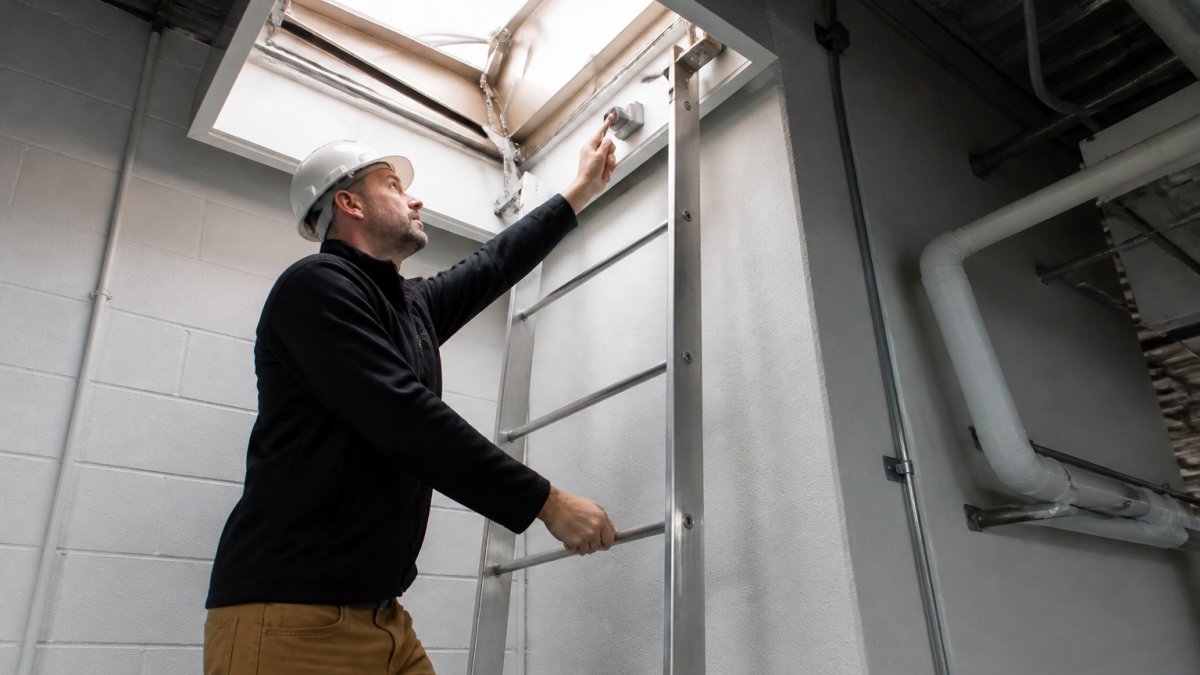
One-hand operation allows staff to maintain three points of contact on the ladder, a fundamental safety requirement for elevated work. Manual hatches force workers to choose between safety and functionality, creating compliance risk.
Motorized models support accessibility compliance by removing physical barriers for aging workforces or staff with limited mobility, allowing technicians with physical limitations to perform roof maintenance.
Weather sealing and hold-open features on motorized units prevent accidental closure incidents, eliminating the hazard of unexpected closure while someone is on the ladder.
Installation must comply with local building codes and roof load requirements. Victory Construction Products provides submittals and specifications to help your project meet requirements and pass inspection.
Motorized hatches demonstrate a higher standard of care and documented commitment to worker safety, reducing liability exposure if incidents occur.
Long-Term Savings and Return on Investment
Facilities with high roof access frequency see faster payback. If your building requires weekly HVAC maintenance, regular rooftop inspections, or antenna servicing, the labor savings accumulate quickly. A motorized hatch saves 10-15 minutes per access cycle compared to manual operation. Over a year, a facility with twice-weekly roof access saves roughly 15-20 hours of labor. At typical maintenance labor rates, this translates to meaningful annual savings.
Buildings with occasional roof access, perhaps twice yearly for seasonal maintenance, see slower payback. The labor savings don't justify the upfront investment unless other factors apply, such as aging staff or compliance requirements.
Hatch lifespan extension is a secondary but real benefit. Motorized models with automated controls reduce the wear that comes from manual operation. Hinges, seals, and mechanical components last longer when the opening and closing cycle is smooth and consistent. A well-maintained motorized hatch can serve 20+ years, while manual models typically last 15-18 years with regular use. This extended lifespan means your next replacement cycle arrives later than it would with a manual unit.
Energy efficiency plays a minor role. Motorized hatches with insulation and weather sealing reduce heat loss through the roof opening when the hatch is closed. This matters most in cold climates where attic ventilation and roof heat management significantly affect heating costs. The energy savings rarely justify motorization on their own, but they contribute to the overall value calculation.
The real ROI question is whether your facility's specific use case matches the motorized hatch profile. High-traffic access points in compliance-sensitive environments justify motorization. Low-traffic, straightforward roof access in mild climates may not.
| Factor | Manual Hatch | Motorized Hatch | ROI Impact |
|---|---|---|---|
| Upfront cost | $757-$1,150 | $2,500-$4,500 | Motorized costs 3-4x more |
| Labor per access | 15-20 minutes | 2-3 minutes | Motorized saves 12-17 min |
| Annual access frequency | Varies | Varies | High frequency favors motorized |
| Hatch lifespan | 15-18 years | 20+ years | Motorized lasts 2-5 years longer |
| Compliance advantage | Limited | Strong | Motorized supports safety standards |
Roof Hatch Maintenance Checklist and Lifecycle Costs
Proper maintenance extends hatch lifespan and prevents costly failures. Both manual and motorized models require regular attention, though motorized units have additional electrical components to monitor.
For any roof hatch, inspect the weather seal twice yearly, spring and fall. Look for cracks, compression, or separation from the frame. A damaged seal allows water infiltration, which leads to interior damage and rust. Replace seals as needed; this typically costs $100-$300 and takes 1-2 hours of labor.

Check hinges and pivot points quarterly. Apply light lubricant to moving parts to prevent corrosion and stiffness. This simple step takes 15 minutes and costs nearly nothing, but prevents expensive hinge replacement later.
For motorized hatches specifically, test the motor and controls monthly. Verify that the hatch opens and closes smoothly through the full range. Listen for unusual sounds that might indicate motor strain or mechanical binding. If the motor sounds rough or the hatch moves unevenly, have it serviced before the problem worsens.
Inspect electrical connections annually. Look for corrosion, loose terminals, or damaged wiring. Moisture and temperature cycling can loosen connections over time. Tightening a loose terminal takes minutes and prevents electrical failure.
Clean the hatch frame and lid quarterly to remove debris, leaves, and dirt. Accumulated debris traps moisture and accelerates corrosion. Use a soft brush and mild soap, avoid high-pressure washing, which can force water into seals.
Lifecycle cost for a motorized hatch over 20 years includes:
- Initial unit and installation: $2,500-$4,500
- Seal replacement (2-3 cycles): $200-$900
- Motor service or replacement (if needed): $500-$1,500
- Annual inspections and maintenance: $200-$400 total over 20 years
- Total estimated lifecycle cost: $3,400-$7,300
A manual hatch over 15 years typically costs:
- Initial unit and installation: $1,200-$2,000
- Seal replacement (2-3 cycles): $200-$900
- Hinge maintenance and repair: $100-$300
- Total estimated lifecycle cost: $1,500-$3,200
The motorized hatch costs more over its lifecycle, but the comparison becomes closer when you factor in labor savings and the extended replacement interval.
Who Should Invest in Motorized Roof Hatches
Motorized roof hatches make financial and operational sense for specific facility types and use cases. Understanding whether your situation fits helps you make the right investment decision.
Facilities with frequent roof access benefit most. This includes commercial buildings with rooftop HVAC systems requiring regular maintenance, data centers with rooftop equipment, and industrial plants with rooftop machinery.
Buildings with aging or mixed-ability workforces gain significant value from motorized operation. Facilities employing staff over 55 or managing workers with mobility limitations find motorization removes a physical barrier to essential maintenance tasks. This demographic consideration often justifies motorization independent of pure ROI calculation.
Compliance-sensitive environments, hospitals, government buildings, research facilities, benefit from the safety documentation that motorized hatches provide. If your facility faces regular safety audits or operates under strict worker-safety protocols, motorization demonstrates commitment to best practices.
Properties with multiple roof access points see stronger ROI. A single motorized hatch might not justify the investment, but three or four hatches across a facility create cumulative labor savings that improve the financial case significantly.
Conversely, motorized hatches don't make sense for occasional-use scenarios. A warehouse with roof access once or twice yearly for inspection doesn't justify the cost. A small office building with a single roof hatch used for emergency antenna repair doesn't need motorization.
Geographic factors matter too. Facilities in cold climates where roof ice and snow create operational challenges sometimes benefit from motorized hatches with integrated heating elements, though this is a specialized application. Facilities in mild climates see minimal additional benefit.
Victory Construction Products stocks motorized and manual options from trusted manufacturers including Bilco, Acudor, Dur-Red, Elmdor, and JL Industries. Our team can help you evaluate your specific facility needs and recommend the right solution.
The Verdict: Is Motorization Worth Your Budget
Motorized roof hatches are worth the investment for facilities with frequent roof access, aging workforces, or strict compliance requirements. For occasional-use scenarios or tight budgets, manual hatches remain a practical, cost-effective option.
The financial case hinges on use frequency. A facility accessing the roof weekly or more will recover the motorization premium within 5-7 years through labor savings, extended hatch lifespan, and reduced maintenance strain. A facility with annual or semi-annual roof access won't reach financial breakeven, making a manual hatch the better choice.
The safety and compliance case is stronger. Motorized operation supports OSHA's fall-prevention principles and demonstrates documented commitment to worker safety. If your facility faces safety audits, manages aging staff, or operates in a compliance-sensitive industry, motorization provides value beyond pure ROI.
The practical case matters most. If your maintenance team currently struggles with manual hatch operation, if staff injuries or near-misses have occurred during roof access, or if you're adding roof access points to an aging facility, motorization solves real operational problems.
Victory Construction Products offers the full range of roof hatch solutions to fit your facility's needs and budget. Our Bilco Roof Hatch delivers one-hand operation and durable construction starting at $1,150. For budget-conscious projects, our Dur-Red Roof Hatch provides proven manual operation at $757, with heavy-duty construction and weather-tight sealing. We also stock Acudor, Elmdor, and JL Industries models to match any specification and budget.
With over 27 years of industry experience and warehouses across 11 states, we provide the expertise, inventory, and logistics support your project needs. Our lowest-price guarantee ensures you're getting the best value, and same-day shipping on most in-stock orders keeps your project timeline on track.
The choice between motorized and manual roof hatches comes down to your facility's specific needs, budget constraints, and long-term operational strategy. Motorized hatches deliver measurable safety, compliance, and labor benefits for high-traffic facilities. Manual hatches remain practical and cost-effective for occasional access. Victory Construction Products carries both options from trusted manufacturers, backed by same-day shipping and our lowest-price guarantee.
Frequently Asked Questions
What are the primary benefits of motorized roof hatches over manual models?
Motorized roof hatches reduce physical strain, improve safety by allowing one-hand operation while keeping the other hand on the ladder, and speed up roof access for frequent users. They comply with OSHA workplace safety standards and reduce injury risk in high-traffic commercial facilities. The trade-off is higher upfront cost and the need for electrical installation and occasional maintenance of motorized components.
How much does a motorized roof hatch cost compared to a manual hatch?
Manual roof hatches from Victory Construction Products range from $757 to $1,150, depending on material and features. Motorized models typically cost 30-50% more upfront due to motor, controls, and electrical installation. While the initial investment is significant, facilities with daily or frequent roof access often recover the cost through reduced labor time over 10-15 years.
What maintenance does a motorized roof hatch require?
Motorized roof hatches need quarterly inspections of hinges, seals, and motor operation; annual lubrication of moving parts; and periodic checks of electrical connections and controls. Manual hatches require less frequent maintenance, primarily weather-seal checks and hinge lubrication every 12-18 months. A roof hatch maintenance checklist should include testing opening and closing cycles, inspecting for rust or corrosion, and verifying weather-tight seals after storms or heavy use.
Do motorized roof hatches comply with OSHA regulations?
OSHA roof access regulations require safe means of access and egress to roofs. Motorized roof hatches support compliance by reducing fall hazards through one-hand operation, allowing workers to keep one hand on the ladder at all times. However, compliance depends on proper installation, regular maintenance, and training. Facilities should verify that their hatch model meets ANSI standards and local building codes before installation.