
Table of Contents
- What Makes a Security Access Door Different from Standard Doors
- Average Cost Per Door Installation and Labor Estimates
- Commercial Access Door Security Ratings and Compliance Standards
- Fire-Rated Access Door Requirements for Code Compliance
- Best Access Door Brands for Contractors: Performance and Durability
- Total Cost of Ownership: Long-Term Value Beyond Purchase Price
- Security Risk Assessment: When the Investment Justifies Itself
- Frequently Asked Questions
Last Updated: September 26, 2026
What Makes a Security Access Door Different from Standard Doors
Whether a security access door is a security access door worth the extra cost depends on whether it delivers capabilities that standard commercial doors simply cannot match. The distinction goes beyond appearance, it's about threat mitigation, credential management, and physical security integration that standard doors lack entirely.
Standard commercial doors operate on basic mechanical locks. Security access doors incorporate electronic strike mechanisms, biometric readers, or card-based authentication systems. They're engineered with reinforced frames, heavier gauge steel panels, and fail-safe or fail-secure configurations that determine how the door behaves during power loss or emergency situations.
The hardware components differ fundamentally. Standard doors use conventional hinges and deadbolts. Security access doors feature welded security hinges, tamperproof latches, and integrated access control panels that communicate with building management systems. This integration allows facility managers to track entry logs, revoke access remotely, and respond to security threats in real time.
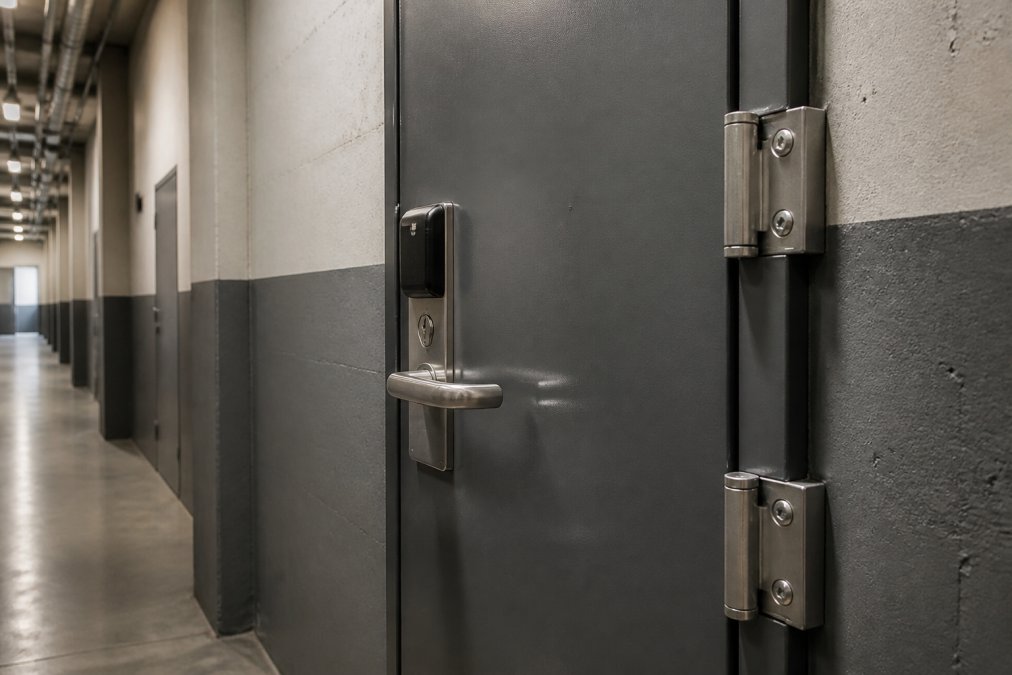
Interior versus exterior requirements also diverge. Interior security access doors manage perimeter protection within buildings, controlling access to server rooms, pharmaceutical storage, or secure facilities. Exterior security doors handle weather exposure, requiring additional weatherstripping and corrosion-resistant materials. Both must integrate with the building's broader access control system, but exterior doors demand additional environmental resilience.
The Acudor SD-6000, designed for high-security applications, exemplifies this difference. With 10-gauge plate door panels and angle frame construction, it provides the structural integrity that prisons and correctional facilities require. Compare this to standard commercial doors, which use thinner gauge materials and basic locking mechanisms unsuitable for detention environments.

Average Cost Per Door Installation and Labor Estimates
Installation costs for a security access door typically range from $200 to $1,500 per opening, depending on door complexity and site conditions. The Elmdor FR Fire Rated Access Door starts at $71, while the JL Industries 2 Hour Fire Rated Inward Swing Access Door reaches $1,065, reflecting differences in materials, fire ratings, and installation difficulty.
Labor represents the largest variable in total project cost. A straightforward retrofit installation of a medium-duty access door in an existing wall opening takes 4-6 hours for a skilled installer. This translates to roughly $400-$800 in labor costs at typical commercial rates. New construction installations run faster, 2-3 hours, because framers can rough the opening to exact specifications before the door arrives.
Man-hour estimation depends on several factors. Is this a retrofit or new construction? Does the opening require reinforcement? Will you need to run new power supply units or low voltage cabling? Each adds 1-3 hours to the project timeline.
The Acudor MS-7000, priced at $215, suits medium-security applications with tamperproof security cam latches and 12-gauge construction. Installation typically requires 3-4 hours for retrofit work. For a facility manager overseeing 50 commercial properties across multiple states, bulk ordering through Victory Construction Products simplifies procurement and ensures consistent hardware across your portfolio.

Commercial Access Door Security Ratings and Compliance Standards
Security ratings define how a door performs under specific threat conditions. The Underwriters Laboratories (UL) standard establishes testing protocols for access doors. UL 10B covers fire-rated doors; ANSI-UL 10B specifies performance metrics for 1.5-hour and 2-hour fire ratings.
The Elmdor FR Fire Rated Access Door meets ANSI-UL 10B standards for 1.5-hour fire protection, carrying a "B" label from Underwriters Laboratories. This certification means the door maintains structural integrity and limits flame penetration for 90 minutes during a standard fire test. Facility managers responsible for compliance audits need this documentation in their maintenance records.
The Milcor UFR Insulated Fire Rated Access Door exceeds basic requirements. It carries both UL and CUL 1.5-hour Class B fire ratings, plus the Warnock Hersey Label for three-hour noncombustible floor and ceiling systems. The insulation limits temperature rise to 250 degrees Fahrenheit after 30 minutes, critical for protecting adjacent spaces from spontaneous ignition.

Compliance standards vary by building type and occupancy. Healthcare facilities must meet Life Safety Code requirements (Resources for Health Care Facility Safety). Data centers require different security ratings than manufacturing plants. Wastewater treatment facilities need corrosion-resistant materials and specific access control configurations. A security audit framework helps identify which doors need upgrades and which rating levels your facility requires.
The JL Industries 2 Hour Fire Rated Inward Swing Access Door accommodates tight space constraints while maintaining 2-hour fire protection. For facilities where standard outward-swing doors won't fit, this inward configuration preserves security without architectural compromises.
Fire-Rated Access Door Requirements for Code Compliance
Fire-rated access doors serve a critical code compliance function. Building codes require fire-rated doors in specific locations: between occupied spaces and mechanical rooms, around elevator shafts, and in fire-rated wall assemblies. Inspectors verify compliance during construction and during periodic facility audits.
The National Fire Protection Association (NFPA) and International Building Code (IBC) define which assemblies require fire-rated doors. A 2-hour fire-rated wall assembly needs 2-hour fire-rated doors at all penetrations. Using a standard door in a fire-rated wall creates a code violation and potential liability exposure.
Access Door – Acudor SD-6000 →
Installation quality directly affects fire rating validity. A fire-rated door installed with gaps around the frame loses its rating. Proper installation includes fire-blocking around the frame perimeter and correct closure devices. This is where professional installation separates compliant projects from failed inspections.
The Milcor UFR provides superior thermal protection compared to uninsulated alternatives. Conventional uninsulated access doors allow temperatures on the protected side to exceed 600 degrees Fahrenheit, creating spontaneous ignition risk. The Milcor's insulation prevents this hazard while maintaining the fire rating.
Best Access Door Brands for Contractors: Performance and Durability
Victory Construction Products stocks five proven access door solutions from trusted manufacturers, each engineered for specific applications and security levels.
The Acudor SD-6000 represents the heavy-duty security tier. Angle frame construction and 10-gauge plate door panels create maximum structural rigidity. Security butt hinges are surface-welded to both door and frame, eliminating mechanical fasteners that could be compromised. The detention-type deadbolt with paracentric key makes this door ideal for correctional facilities, prisons, and high-security housing projects. At $645, it's the premium option for environments where security cannot be compromised.
The Acudor MS-7000 delivers medium-duty security at $215. The 12-gauge door and frame construction with tamperproof security cam latches suits psychiatric institutions, medium-security jails, and similar facilities. Rounded safety corners provide an architecturally pleasing appearance while the one-piece trim flange and continuous concealed hinge prevent racking, sagging, or distortion over time.
The Milcor UFR Insulated Fire Rated Access Door at $240 prioritizes thermal protection. Its UL and CUL 1.5-hour fire rating combined with 250-degree temperature rise protection makes it essential for fire-rated wall assemblies. The automatic panel closer ensures positive latching without manual intervention, critical for maintaining fire rating integrity in occupied buildings.
The JL Industries 2 Hour Fire Rated Inward Swing Access Door at $1,065 solves space constraints. When outward-swing doors won't fit architectural requirements, this inward configuration maintains full 2-hour fire protection. The 10-day lead time requires advance planning, but contractors managing complex renovation projects value having this option available.
The Elmdor FR Fire Rated Access Door at $71 provides entry-level fire protection. Meeting ANSI-UL 10B standards for 1.5-hour fire rating with a "B" label, it serves straightforward code compliance needs in commercial buildings where maximum security isn't required. The heavy-duty spring closer ensures positive latching.
Victory Construction Products guarantees same-day shipping on most in-stock orders from its 11 warehouse locations across the country.
Total Cost of Ownership: Long-Term Value Beyond Purchase Price
Purchase price captures only the initial outlay. Total cost of ownership includes installation labor, system integration, maintenance overhead, and security risk mitigation over the door's operational lifespan.
Security Risk Assessment: When the Investment Justifies Itself
A security risk assessment framework helps determine whether upgrading to security access doors makes financial sense for your facility.
Frequently Asked Questions
What is the average cost to install a security access door?
Security access door costs range from $71 to $1,065 depending on the door type and specifications. The Elmdor FR Fire Rated Access Door starts at $71, while the JL Industries 2 Hour Fire Rated Inward Swing model costs $1,065. Installation labor typically adds $200-$500 per opening, depending on complexity and local rates. Total project costs increase with multiple entry points, specialized hardware, and integration with credential management systems. Budget for site assessment and any structural modifications needed.
How does a security access door differ from a standard commercial access panel?
Security access doors feature reinforced construction, specialized locking mechanisms, and tamperproof hardware designed to resist forced entry. Standard panels lack these protections. The Acudor MS-7000 uses 12-gauge steel and tamperproof security cam latches, while the SD-6000 employs angle frame construction and detention-type deadbolts. Security doors also integrate with access control systems, credential management, and user access logs. They provide physical security layer protection that standard doors cannot match, making them essential for facilities managing sensitive areas or high-risk entry points.
Do security access doors meet NFPA fire safety standards?
Fire-rated access doors meet UL and NFPA standards when specified correctly. The Milcor UFR carries UL and CUL 1.5-hour Class B fire rating and limits temperature rise to 250 degrees Fahrenheit, preventing spontaneous ignition of nearby materials. The Elmdor FR meets ANSI-UL 10B standard with 1.5-hour fire rating. Compliance depends on selecting doors rated for your facility's risk level and building code requirements. Always verify that your chosen door matches local fire safety audit requirements and building inspector specifications before installation.
What factors influence whether a security access door is worth the investment?
ROI depends on facility risk level, entry point volume, compliance requirements, and long-term maintenance costs. High-security facilities (prisons, psychiatric institutions, data centers) justify premium doors immediately through threat mitigation and liability reduction. Facilities managing 10+ entry points see better ROI through system integration and reduced credential management overhead. Fire-rated requirements add cost but are non-negotiable in code-controlled spaces. Calculate total cost of ownership including installation labor, maintenance, system integration, and property valuation impact. Most commercial properties see positive ROI within 3-5 years through reduced security incidents and compliance avoidance.