
Table of Contents
- Why Hardware Inventory Control Makes or Breaks Commercial Timelines
- 1. Set Reorder Points Before You Set Foot on Site
- 2. Best Practices for Construction Material Tracking That Hold Up Under Pressure
- 3. Preventing Inventory Shrinkage on Job Sites Without Slowing Down Crews
- 4. When Construction Inventory Management Software Is Worth It (And When It Isn't)
- 5. Managing Hardware Across Multiple Job Sites and Subcontractors
- 6. Vendor Management and Procurement Standardization
- 7. Reducing Material Waste and Reusing What You Can
- Frequently Asked Questions
Last Updated: September 11, 2026
Why Hardware Inventory Control Makes or Breaks Commercial Timelines
A missing fire-rated access door stalls the entire inspection sequence behind it. This guide from Victory Construction Products covers the hardware inventory management tips that keep doors, hatches, and fire protection equipment moving onto the job on schedule.

Hardware inventory management is the practice of tracking, storing, and replenishing the access doors, roof hatches, floor doors, and fire-rated assemblies a commercial project needs, from purchase order through final installation. Get it right and crews never wait; get it wrong and you pay for idle labor while a single door sits two states away.
The Real Cost of a Missing Fire-Rated Access Door
A fire-rated door is not interchangeable with a general-purpose panel (nfpa.org). It carries a rating the authority having jurisdiction verifies during inspection. If the wrong model shows up, or nothing shows up, you either wait for the correct unit or fail the inspection and reschedule. Both cost money, and neither shows up clearly on a budget line until the project is already behind.
What Poor Tracking Does to Your Schedule and Budget
Most contractors track hardware loosely, like consumables, because each item looks inexpensive next to structural steel or glazing. That hides the real exposure: a delayed fire door can hold up drywall close-in, ceiling grid, and final inspection sign-off across multiple floors.
The fix is not more spreadsheets. It is a system that tells you what you have, where it is, and when to reorder before a crew waits.
1. Set Reorder Points Before You Set Foot on Site
A reorder point is the stock level that triggers a new purchase order before you run out. Set it by working backward from lead time, not by guessing.
Start with three numbers per item: weekly usage, vendor lead time, and buffer for weather or scheduling slips. Multiply weekly usage by lead time, then add your buffer.
For high-value or long-lead hardware, add a second trigger. A fire-rated access door that takes longer to source than a general-purpose panel needs its own threshold and owner.

2. Best Practices for Construction Material Tracking That Hold Up Under Pressure
Best practices for construction material tracking come down to one principle: capture data at the moment of movement, not at the end of the week. Anything logged later is a guess. Every delivery, transfer, and install gets recorded by whoever physically handles the item, a superintendent logging a delivery three days late is writing fiction.
Barcode Scanning and RFID Tracking for High-Value Hardware
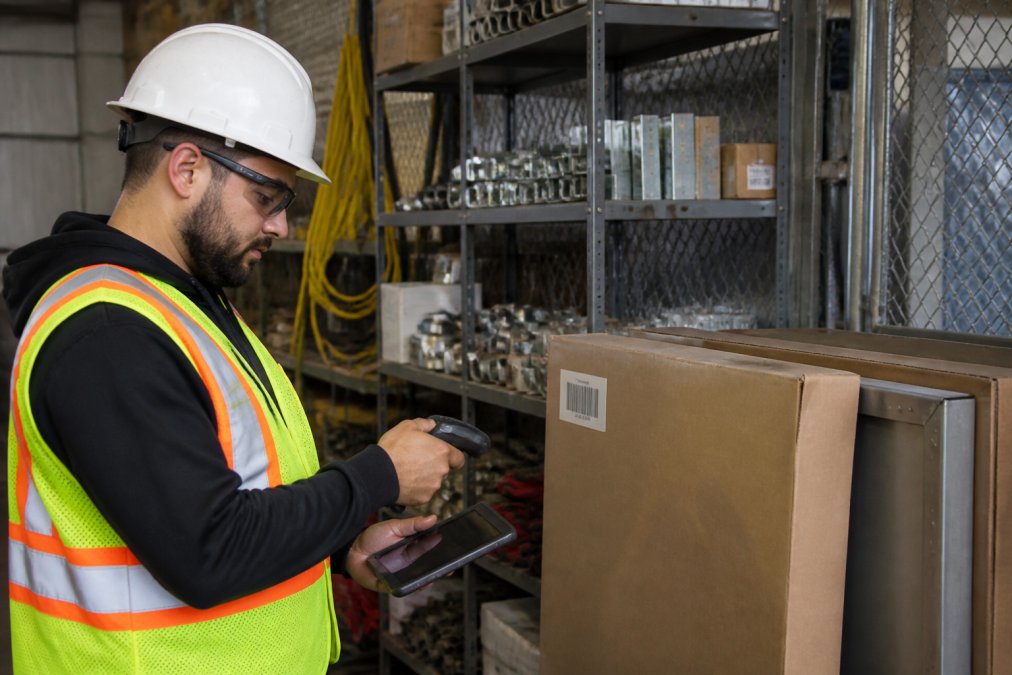
Barcode scanning works well for boxed access doors and panels: a scan at receiving and again at install gives you a real-time count without a data entry session. RFID goes further for items that move frequently or sit in unsecured areas, letting you locate stock without opening every crate. The trade-off is cost per tag, so most contractors reserve RFID for the items that would hurt most to lose.
Cycle Counting Instead of Annual Audits
Annual audits tell you what went wrong last year; cycle counting tells you what is wrong today. Count a rotating subset of your stock weekly, with high-value and high-movement items counted more often. By quarter's end you have audited everything without shutting down for a full physical inventory.
| Tracking Method | Best For | Effort Level | Accuracy Gain |
|---|---|---|---|
| Manual log | Small crews, low volume | Low | Baseline |
| Barcode scanning | Boxed doors, panels | Medium | High |
| RFID tracking | High-value, high-movement | High | Highest |
| Cycle counting | All stock, ongoing | Medium | Sustained |
3. Preventing Inventory Shrinkage on Job Sites Without Slowing Down Crews
Preventing inventory shrinkage on job sites starts with accepting that shrinkage is usually internal, not external (nrf.com). Theft gets the headlines. Misplacement, damage, and untracked transfers cause more loss on most commercial projects.
Physical Site Security: Lockups, Sign-Outs, and Chain of Custody
A chain of custody means every item has a named person responsible for it from delivery to install. That requires no security guard, just a sign-out sheet and a locked container only two or three people can access. Lockups should be dry, organized, and separate from general storage; hardware left in an open laydown area overnight is hardware you are choosing to risk.
Theft Patterns Contractors Miss Until It's Too Late
The pattern that catches contractors off guard is not a break-in but gradual removal by people with legitimate site access. A few doors disappearing over several weeks rarely triggers alarm because no single event looks like theft. Cycle counting catches this, as does comparing installed against delivered quantities at each phase close.
4. When Construction Inventory Management Software Is Worth It (And When It Isn't)
Construction inventory management software earns its cost when you run multiple sites, multiple crews, or a mix of stocked and drop-shipped hardware. Below that threshold, a disciplined spreadsheet and a locked container often do the job. Software does not fix a process problem: if your team does not log movements today, a new platform just gives you a cleaner view of bad data.
A Lean Manual System for Small-Scale Subcontractors
Most inventory guides are written for general contractors running enterprise platforms. A small crew, under 15 field staff and one or two active jobs, does not need a warehouse management system. It needs a system a foreman will actually use at 6:30 a.m. with gloves on.
Here is a lean setup that works without software:
- One bin, one label, one count. Every hardware SKU gets a labeled bin or shelf position. The label shows the SKU, the reorder point, and the vendor phone number. No label, no accountability.
- A receiving clipboard with three columns. Date, quantity received, initials. Whoever signs for the delivery writes the line. That sheet becomes your receiving log and dispute record if a vendor short-ships.
- A weekly 15-minute count. Pick the five highest-value or fastest-moving SKUs and count them every Friday. Rotate the list so everything gets counted once a quarter, cycle counting at a scale a small crew can sustain.
- A shared cloud spreadsheet with one owner. One person, not "the team", is accountable for accuracy. If nobody owns the sheet, the sheet is fiction.
- A locked job box on every active site. Even a small crew loses hardware to misplacement and casual removal. A job box with a sign-out sheet costs less than one misordered fire door.
This system will not scale past a handful of sites. That is the point. Adopt software when the manual system starts failing, when you cannot reconcile transfers, when reorder points get missed across sites, or when job costing takes more than a day to close.
What to Look For When You Do Buy Software
Small subcontractors get the most value from software that handles receiving, job costing, and reorder alerts without a lengthy implementation. Cloud-based tools with mobile scanning fit better than warehouse management systems built for distribution centers. Prioritize three capabilities: mobile receiving at the point of delivery, per-job cost allocation, and reorder alerts tied to lead time rather than a flat minimum. Skip anything requiring a dedicated inventory clerk, if the tool needs a full-time admin, you have bought a second job.
BIM Integration and What It Changes
BIM integration ties hardware quantities to the model, so material tracking updates as the design evolves. When a door schedule changes, your procurement list changes with it: the schedule exported from the model becomes the source of truth for quantities, and any field-verified count gets reconciled against it at each phase.
This is the gap most inventory guides skip. Commercial projects rarely build exactly what was drawn, and without a link between the model and your stock list, every design change becomes a manual reconciliation where counts drift. Even a lightweight workflow (export the schedule, compare to on-hand, flag variances) captures most of the benefit without a full BIM platform.
5. Managing Hardware Across Multiple Job Sites and Subcontractors
Managing hardware across multiple job sites fails when each site tracks independently and nobody reconciles transfers. A door that leaves Site A for Site B needs a record at both ends, or it vanishes.
Transfer Documentation That Actually Closes the Loop
A transfer is not a phone call, it is a two-sided record. The sending site logs the SKU, quantity, condition, and destination; the receiving site logs the same line and confirms it. Until both sides match, the item sits in a limbo state no report catches.
The mechanism is a transfer log, paper or digital, with a required receiving confirmation. If the receiving site does not confirm within 48 hours, the sending site's owner follows up. Without that step, transfers become the largest source of phantom inventory on multi-site operations.
Subcontractor Coordination and Weekly Reconciliation
Your electrical or mechanical sub may install hardware you purchased, so your inventory count and their installed count have to meet somewhere. Set a weekly reconciliation and assign one person per site to own it.
The reconciliation compares three numbers per SKU: delivered, transferred in or out, and installed. Any gap between delivered-minus-transferred and installed is on the shelf, in transit, damaged, or missing. Naming which forces the conversation that prevents a punch-list surprise.
Physical Site Security Across Multiple Sites
Most guides focus on software and skip the physical layer, where multi-site losses actually happen.
- Lockups per site, not per company. Each active site needs its own dry, locked container for high-value hardware. A shared lockup two sites away is a lockup nobody uses.
- Sign-out sheets with named custody. Every removal, to a sub, to another site, to install, gets a name and a time. Anonymous removals are untraceable removals.
- Limited key or code access. Two or three people per site, maximum. Every additional person with access is an additional person who can move hardware without a record.
- Reconcile delivered vs. installed at each phase close. This is the single most effective theft-detection tool on a multi-site operation. Gradual removal by people with legitimate access rarely triggers alarm on any single event, but it always shows up as a delivered-versus-installed gap at phase close.
Centralize Purchasing, Localize Storage
Centralize purchasing even when storage stays local. One purchase order stream gives you visibility into total spend and prevents three sites from ordering the same item on the same day. Local storage keeps lead time short for the site that needs the item now. The two are not in conflict, they are the operating model.
6. Vendor Management and Procurement Standardization
Standardizing procurement means limiting how many models and vendors your teams can order from without approval. Every added SKU adds a stocking decision, a lead time, and a failure point.
Build a short approved list per hardware category. For access doors, that might mean one fire-rated model and one general-purpose panel as defaults, with exceptions requiring sign-off. Victory Construction Products stocks access hardware from 15 trusted brands across warehouses in 11 states, keeping model numbers, pricing, and submittals in one place instead of scattered across vendor portals.
Vendor management is not about squeezing price. It is about knowing lead times, confirming stock before you commit a schedule to it, and having a backup source for anything on the critical path.
7. Reducing Material Waste and Reusing What You Can
Waste reduction on commercial projects usually means recovering hardware ordered for a scope change, a canceled phase, or a misordered model. Most of it is perfectly usable and gets written off because nobody tracks where it went.
Set up a returns and reuse process: anything pulled from a site goes back into a central stock record with its condition noted, not into a dumpster. Over several projects, that recovered stock covers real quantities of general-purpose panels and smaller hardware. Sustainability and material reuse also play into owner reporting now, recovered and reused hardware is a concrete number, not a vague claim.
For fire-rated assemblies, reuse has a limit. Once a rated door or frame is damaged or modified, it may no longer carry its rating, and the authority having jurisdiction can reject it at inspection (nfpa.org). Reuse general-purpose hardware freely. Verify rated assemblies before you reinstall them.
Frequently Asked Questions
What is the best way to track construction materials on-site?
Combine barcode scanning with a simple cloud-based log. Tag every high-value item, like fire-rated access doors, at delivery, then scan it in and out of the site lockup. For hardware under $50, use bin-level cycle counts instead of individual tracking. This keeps data accuracy high without slowing crews. A weekly cycle count on your top 20 items catches discrepancies before they become expensive shortages.
How do you manage inventory for small construction hardware items?
Small hardware like fasteners, hinges, and latches rarely justifies individual tracking. Use bin systems with min/max levels and reorder points set at two weeks of average use. Label each bin with the part number and reorder trigger. When a bin hits the line, whoever pulls the last item flags it for reorder. This approach costs nothing to set up and prevents the small-item stockouts that stall door installations.
What are the common causes of inventory shrinkage in construction?
The biggest causes are unrecorded pulls by crews who need a part fast, damage during storage, and theft from unsecured job sites. Subcontractor coordination gaps also contribute when two trades assume the other is tracking shared materials. Physical site security, sign-out logs, and a single point of accountability for each hardware category address most shrinkage. Cycle counting catches what process gaps remain.
What technology is best for tracking access doors and fire safety hardware?
For fire-rated access doors and roof hatches, use barcode scanning tied to your purchase orders and submittals. These items have model numbers and fire ratings that must match specs, so scanning at delivery confirms you received the right product. RFID tracking works for high-volume sites with hundreds of units. For smaller operations, a spreadsheet with barcode input handles the job without software overhead.
Commercial timelines do not fail because of one big mistake. They fail because a fire-rated door shows up late, a crew waits, and the inspection sequence slips by a week. Victory Construction Products exists to remove that failure point, with over 27 years of industry experience, same-day shipping on most in-stock orders, and a lowest-price guarantee across 15 trusted brands. Pull model numbers, pricing, and submittals directly from the site, then add to cart and keep your project on schedule.