
Table of Contents
- Why Small Contractors Get Overlooked in Commercial Access Hardware
- How to Choose Commercial Door Hardware for Your Project
- Fire-Rated Access Door Requirements You Can't Afford to Miss
- Commercial Hardware Procurement Strategies That Save Time and Money
- Access Door Options Built for Small Contractor Budgets
- Common Mistakes Small Contractors Make With Access Hardware
- Frequently Asked Questions
Last Updated: September 10, 2026
Why Small Contractors Get Overlooked in Commercial Access Hardware
Ask a supply house counter for commercial access hardware for small contractors and you'll get the same answer: order in pallet quantities or wait three weeks, a problem when you need a few access doors, closers, and panic bars for a Monday start.
This guide from Victory Construction Products is built for the contractor running two to fifteen people, not the national account with a procurement department. We'll cover choosing hardware by grade and traffic, fire-rated opening requirements, and where small contractors lose money on procurement.
Commercial access hardware is the collective term for the components that let people pass through a commercial opening safely and securely: locksets, exit devices, closers, hinges, pivots, thresholds, and access panels. Get the mix wrong and you fail inspection. Get the procurement wrong and you eat the cost.
The Procurement Gap: Big Distributors vs. Small Crews
Large distributors optimize for volume accounts: pricing tiers, freight minimums, and will-call policies are built around buyers who order by the truckload. A crew needing six access doors and a dozen hinges isn't worth their time.
That gap creates real problems on a job site:
- Minimum order quantities that force you to buy more hardware than the project needs
- Freight charges that erase the margin on small orders
- Lead times quoted in weeks when your schedule is measured in days
- Submittal support that disappears once you're below a certain order size
What a Contractor-First Supply Chain Actually Looks Like
A supply chain built for small crews stocks common models, ships same-day on in-stock items, and publishes model numbers, pricing, and submittals online.
Victory Construction Products runs this model directly: in-stock access doors, roof hatches, floor doors, and fire protection equipment from 15 trusted brands, backed by a lowest-price guarantee and same-day shipping on most in-stock orders. For a crew needing three doors by Thursday, that's the difference between finishing the punch list and pushing the schedule.
How to Choose Commercial Door Hardware for Your Project
Choosing commercial door hardware comes down to three variables: traffic volume, fire rating, and the door prep already in the frame. Match all three and the hardware lasts. Miss one and you're back on site within a year.
The selection process most contractors use:
- Confirm the fire rating of the opening (or confirm it's non-rated)
- Count daily cycles to set the hardware grade
- Verify the door prep, backset, and strike dimensions before ordering
- Match the closer to the door weight and width
- Confirm the exit device meets egress requirements for the occupancy
Matching Hardware Grade to Traffic and Use
Hardware grades follow a three-tier system set by ANSI/BHMA standards, and the grade you pick should track directly to how many times the door opens each day (buildershardware.com).
| Grade | Cycle Rating | Best For | Typical Openings |
|---|---|---|---|
| Grade 1 | Heavy-duty, highest cycle rating | High-traffic, institutional | Schools, hospitals, main entries |
| Grade 2 | Medium-duty | Commercial general use | Offices, retail, tenant spaces |
| Grade 3 | Light-duty, residential-grade | Low-traffic | Closets, back-of-house, storage |
Grade 1 costs more upfront but survives abuse that destroys Grade 3 in a year. For a storefront entry or busy corridor, Grade 1 is the only sensible choice; for a mechanical closet opening twice a week, Grade 3 saves budget.
The Compatibility Check Most Contractors Skip
A common mistake is ordering before confirming the door prep. A cylindrical lock needs a specific cross-bore and backset; a mortise lock needs a pocket cut into the door edge; a panic bar needs the right rod or rim configuration.
Measure before you order:
- Backset (distance from door edge to the center of the bore)
- Door thickness (standard is 1-3/4 inches for commercial)
- Strike plate dimensions and frame type
- Handing (left-hand, right-hand, or reversible)
- Existing hinge or pivot locations
When retrofitting, photograph the door edge and frame before ordering. It saves a return shipment.
Fire-Rated Access Door Requirements You Can't Afford to Miss
Fire-rated access door requirements are non-negotiable: the assembly must carry a label from a recognized testing agency, and every component, the door, frame, hinges, closer, and latch, must be rated for that opening. Mixing a rated door with non-rated hardware voids the assembly.
The label tells you the rating period (typically 20, 45, 60, or 90 minutes), the testing standard, and whether it's approved for the wall type, but not whether your hardware is compatible (ul.com).
What the Label Tells You (and What It Doesn't)
A fire door label confirms the door slab passed its test. It does not confirm:
- That your closer is rated for the door weight
- That your hinges carry a fire rating
- That your exit device meets life safety code for the occupancy
- That the frame was installed to the manufacturer's specification
For access panels in fire-rated walls, the panel itself must carry a fire rating matching the wall assembly. The UL fire door and access panel marking guide explains how to read those labels. If you're unsure, ask the supplier for the submittal package before the panel ships.
Commercial Hardware Procurement Strategies That Save Time and Money
Most hardware guides are written for the end user or facilities manager. Almost none address how a two-to-fifteen-person crew actually buys hardware: small quantities, short notice, against a schedule that won't wait for a distributor's order cycle.
The Small-Order Problem, Quantified
The friction on small orders isn't the unit price, it's everything around it:
- Minimum order quantities that force you to buy a full box when you need two pieces, tying up cash and leaving dead inventory in the trailer.
- Freight minimums that add a flat charge to a small order, sometimes exceeding the hardware cost itself.
- Lead times quoted in weeks on items the distributor doesn't stock, even when the manufacturer ships same-day.
- Will-call windows that assume you have someone who can sit at the counter during business hours.
- Submittal support that disappears below a certain order size, leaving you to assemble the package yourself.
Over-ordering "just in case" solves the schedule problem and creates a cash problem. Buy from a supplier built around small orders, not one that tolerates them.
What to Look For in a Contractor-First Supplier
When you're evaluating where to buy, these are the operational questions that matter more than the catalog:
- Is the item actually in stock, or "available to order"? In-stock means it ships today. Available to order means it ships when the manufacturer ships, which is a different lead time entirely.
- Is there a minimum order or a freight minimum? If yes, what's the threshold, and does it apply to will-call?
- Are pricing, model numbers, and submittals published online? If you have to email for a quote on every line item, you're paying for that in time.
- What's the return policy on opened hardware? Electrical and life-safety components often can't be returned once opened. Know before you order.
- Can you get a submittal package generated from the order? This is the single biggest time-saver on commercial work.
Building a Submittal-Ready Hardware Package
A submittal package is the documentation the architect or inspector needs to approve your hardware: product data sheets, fire rating certificates, finish specifications, and templates. Assembling it project by project wastes hours.
Build a master file instead:
- One folder per hardware category (locksets, closers, exit devices, access doors)
- Current cut sheets and fire certificates for every model you spec regularly
- A template cover sheet with project name, spec section, and date
- A compatibility matrix showing which models work with which door preps
When a project comes up, you copy the relevant sheets, fill in the cover, and submit. What used to take a day takes an hour.
Standardize Your Spec, Then Buy in Batches
The fastest workflow is the one where you're not making decisions on every job. Pick a small set of models you trust, one cylindrical lock, one mortise lock, one rim exit device, one closer series, one or two access door models, and spec them by default. Then:
- Buy common consumables in batch when you have a project that justifies it. Hinges, strikes, and fasteners don't expire, and buying them in slightly larger quantities when you're already placing an order avoids a second freight charge later.
- Keep a job-trailer stock of the models you install most. A small crew that can pull a closer off the truck instead of ordering one saves a day on every service call.
- Track what you actually use for a quarter. Most crews overstock two or three items and understock the one they need most.
Budget vs. Lifecycle Cost: Where Small Contractors Win
The cheapest hardware is rarely the least expensive. A Grade 3 closer on a high-traffic corridor door might save a few dollars at purchase and cost three times that in replacement labor within two years.
Run the math on lifecycle cost:
- Purchase price
- Installation labor
- Expected service life at the actual cycle count
- Replacement labor when it fails early
- Downtime cost if the opening is out of service
For a door cycling 200 times a day, Grade 1 hardware almost always wins on lifecycle cost. For a door cycling twice a day, it usually doesn't. Match the grade to the actual use, not to the budget line.
The upsell angle is real: show a client the five-year cost of a cheap closer versus a Grade 1 unit and the higher-grade spec sells itself. Most small contractors never have that conversation because they quote the lowest line item instead of the lowest total cost.
Access Door Options Built for Small Contractor Budgets
Access doors are the workhorse of commercial access hardware, and small contractors need options that install fast without a custom lead time. Four models cover most jobs.
The JL Industries TM is a general-purpose panel for wallboard, plaster, masonry, brick, or paneling. The 1-inch flange covers the cut opening, forgiving rough cuts, a solid pick for plumbing, HVAC, and communications access where the finish doesn't need to be perfect.

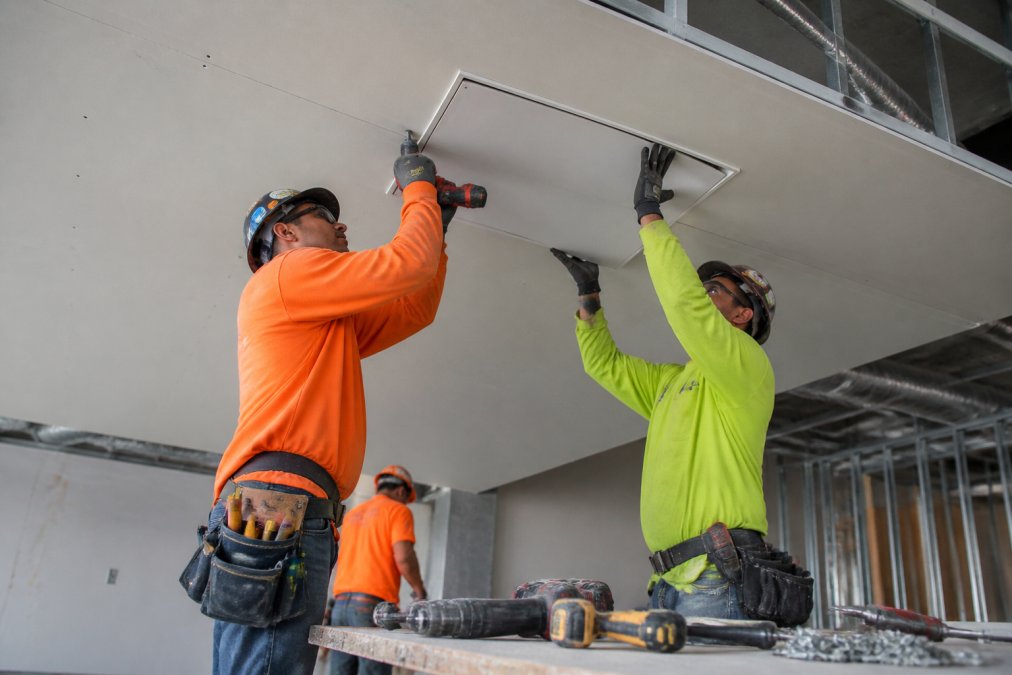
The Elmdor DW suits new installations and remodels in masonry, tile, wood, or other wall and ceiling surfaces. Rounded safety corners and 16-gauge galvannealed steel with a prime coat finish make it durable for regular use.
For openings that need full clearance, the Milcor M uses a 16-gauge one-piece frame providing a 100% clear opening. Concealed spring hinges open to 175 degrees, so the panel swings clear without impacting the wall, and the cam latch release moves the door edge outward for easy grip.
The Cendrex AHD is designed for quick installation on non-rated vertical and horizontal surfaces. Its rounded mitered corners, concealed pin hinge, and 3/8-inch return all around make it sturdier than a flat panel and resistant to sagging.
| Model | Best For | Key Feature | Starting Price |
|---|---|---|---|
| JL Industries TM | General-purpose wall or ceiling | 1" flange covers cut opening | $40.00 |
| Elmdor DW | New installs and remodels | 16-gauge galvannealed steel | $132.00 |
| Milcor M | Full-clearance access | 175-degree concealed spring hinges | $77.95 |
| Cendrex AHD | Non-rated drywall surfaces | 3/8" return resists sagging | $40.60 |
Common Mistakes Small Contractors Make With Access Hardware
Mistakes with access hardware usually trace back to ordering too fast or measuring too little. These cost the most.
Ordering hardware before confirming the door prep. A cylindrical lock that doesn't match the existing bore is a return and a delay. Measure backset, thickness, and handing first.
Mixing rated and non-rated components. A fire-rated door with a non-rated closer fails inspection. Every component in the assembly must carry the rating.
Specifying Grade 3 hardware on high-traffic openings. It saves money at purchase and costs more in replacement labor within a couple of years.
Skipping the closer adjustment. A closer that slams or won't latch is usually a speed and latching adjustment, not a defective unit. Set the sweep and latch speed on installation.
Forgetting the threshold and weatherstripping on exterior openings. Gaps at the threshold let water in and fail the door's rated performance.
Buying from a supplier that doesn't stock the model. A low price on a two-week lead time isn't a low price if it pushes your schedule.
Victory Construction Products stocks access doors and hardware from 15 brands across warehouses in 11 states, so a small crew can order a few doors at a time without minimums or long lead times. Model numbers, pricing, and submittals are all in one place online.
Frequently Asked Questions
What are the different types of commercial access hardware?
Commercial access hardware covers several categories: access doors and panels for walls and ceilings, door closers, exit devices and panic bars, locksets (mortise and cylindrical), hinges and pivots, thresholds, and strike plates. For small contractors, the most common items are general-purpose access doors, fire-rated panels, and heavy-duty closers. Each type has grade ratings (Grade 1 for high-traffic, Grade 2 for moderate use) and specific code requirements depending on the building type and opening location.
How do I choose the right commercial access hardware for a project?
Start with three questions: What is the wall or ceiling material? Is the opening fire-rated? How much traffic will it see? A general-purpose access door like the JL Industries TM works for drywall and plaster in low-traffic areas. For fire-rated assemblies, you need a labeled door that matches the wall's hourly rating. Match hardware grade to traffic: Grade 1 for schools and hospitals, Grade 2 for offices. Always verify door prep and frame compatibility before ordering.
What fire-rated access door requirements apply to commercial projects?
Fire-rated access doors must carry a label from a recognized testing agency (UL, FM, or Intertek) showing the hourly rating, typically 1, 1.5, or 2 hours. The door must match or exceed the rating of the wall or ceiling it's installed in. Installation requires the correct frame type and clearances. Local building codes and the Life Safety Code (NFPA 101) govern where fire-rated doors are required. Always check the approved submittal before installation.
Can small contractors order just a few access doors without minimum order fees?
Yes. Distributors that serve small contractors typically have no minimum order quantity on standard access doors. You can order one JL Industries TM door at $40.00 or a single Elmdor DW at $132.00 without penalty. The key is choosing a supplier with in-stock inventory and same-day shipping, so a small order doesn't become a scheduling problem. Always confirm stock status before promising a delivery date to your GC.
The hardest part of commercial access hardware for a small contractor isn't the installation. It's getting the right parts on site before the schedule slips. Victory Construction Products was built for that problem: over 27 years of experience, same-day shipping on most in-stock orders, a lowest-price guarantee, and a catalog of access doors, roof hatches, floor doors, and fire protection equipment from 15 trusted brands. Check the model numbers, pull the submittals, and add to cart.