
Table of Contents
- Why Buy Fire Protection Equipment Online from a Specialized Distributor
- Fire Protection Equipment Procurement Checklist: What to Verify Before You Order
- Understanding UL-Listed Fire Safety Equipment Standards
- NFPA Fire Safety Compliance Requirements for Commercial Buildings
- Choosing Fire Extinguishers and Cabinets for Your Facility
- Fire Protection Equipment Maintenance and Inspection Schedules
- Buy Fire Protection Equipment Online: Common Mistakes to Avoid
- Build a Safer Facility with the Right Fire Protection Equipment
- Frequently Asked Questions
Last Updated: September 6, 2026
Why Buy Fire Protection Equipment Online from a Specialized Distributor
Fire protection equipment is a life safety investment, not a commodity purchase. A specialized distributor provides verified product specifications, compliance documentation, and technical support that generic retailers cannot.
A non-UL-listed extinguisher, a cabinet failing code visibility, or a mis-zoned alarm can fail during an inspection or incident. Commercial buildings carry specific obligations under NFPA standards.
Fire Protection Equipment Procurement Checklist: What to Verify Before You Order
A structured procurement checklist prevents costly returns and compliance failures. Before you add any fire protection equipment to your cart, verify these five elements against your building's specific requirements.
- UL Listing: Confirm the product carries a current UL mark. This is non-negotiable for commercial installations.
- NFPA Code Alignment: Match the equipment class and placement to the applicable NFPA standard for your occupancy type.
- Submittal Documentation: Request manufacturer cut sheets and submittals before purchase, not after delivery.
- Cabinet Dimensions: Measure the recess depth and wall thickness where the cabinet will mount.
- Shipping and Hazmat Fees: Dry chemical extinguishers ship with hazmat fees. Factor these into your total cost.
Confirm the extinguisher rating matches each area's hazards; a mixed-use building needs different classifications than a mechanical contractor working near energized equipment.

Understanding UL-Listed Fire Safety Equipment Standards
UL listing independently verifies that a fire protection product has been tested and meets recognized safety and performance standards.
UL testing covers specific fire class performance. An ABC dry chemical extinguisher is tested against Classes A, B, and C; a CO2 extinguisher suits sensitive electronics because it leaves no residue, but not cooking oil or grease fires.
When you buy fire protection equipment online, the UL mark should be visible in the product images and listed in the specifications. If a listing omits this detail, treat it as a red flag. The UL Solutions database of listed products allows you to verify any certification number directly, which is a prudent step before committing to a bulk order.
NFPA Fire Safety Compliance Requirements for Commercial Buildings
Commercial fire safety compliance is governed by National Fire Protection Association codes covering extinguisher placement to inspection frequency. Primary standards include NFPA 10, NFPA 72, and NFPA 101.
NFPA 10 requires the carrying handle to sit between 3.5 and 5 feet above the floor, with the unit visible or its location clearly marked. This makes cabinets a compliance tool, not just storage.
The NFPA 10 standard for portable fire extinguishers also addresses clearance requirements and the maximum travel distance to an extinguisher based on the fire class. Facility managers responsible for multiple properties should maintain a compliance matrix that maps each code requirement to the specific equipment installed. That documentation becomes your evidence during annual inspections by the authority having jurisdiction.
Choosing Fire Extinguishers and Cabinets for Your Facility
Selecting the correct extinguisher and cabinet means matching the agent to the fire classes present in each area. Using the wrong agent can be ineffective or dangerous. This 'Help Me Choose' guide walks through the decision by hazard type.
Step 1: Identify the Fire Classes in Each Zone
Walk your facility floor-by-floor and classify potential fire hazards in every room, the single most important selection step.
- Class A (Ordinary Combustibles): Wood, paper, cloth, trash, and most plastics. Present in virtually every area, from offices to storage rooms.
- Class B (Flammable Liquids and Gases): Gasoline, oil, solvents, propane, and paints. Common in maintenance shops, parking garages, and chemical storage areas.
- Class C (Energized Electrical Equipment): Motors, panels, servers, and wiring. Relevant in electrical rooms, data centers, and any area with live circuits.
- Class D (Combustible Metals): Magnesium, titanium, sodium, and lithium. Found in machine shops, laboratories, and manufacturing lines that work with these metals.
- Class K (Cooking Oils and Fats): Vegetable oils, animal fats, and grease. Confined to commercial kitchens and food processing areas.
A single facility rarely has one hazard class; a mixed-use building will have Class A in hallways, Class C in the electrical room, and Class K in the cafeteria kitchen.
Step 2: Match the Agent to the Hazard
Once fire classes are mapped, agent selection becomes systematic. The table below outlines the standard agent-to-hazard match and trade-offs to weigh before ordering.
| Agent Type | Fire Classes | Best For | Key Trade-Off |
|---|---|---|---|
| ABC Dry Chemical (Monoammonium Phosphate) | A, B, C | General commercial spaces: offices, classrooms, retail, hotel corridors | Leaves a corrosive residue that can damage electronics and requires cleanup after discharge |
| Carbon Dioxide (CO2) | B, C | Electrical rooms, server closets, labs, printing facilities | Leaves no residue, but the discharge is loud and the agent dissipates quickly, not for outdoor or windy areas |
| Class K (Wet Chemical) | K | Commercial kitchens, deep fryers, hood systems | Specifically formulated to cool and blanket cooking oils; ineffective on Class A combustibles |
| Purple K (Potassium Bicarbonate) | B, C | Fuel depots, chemical plants, high-hazard industrial | More effective on flammable liquids than ABC dry chemical, but corrosive and not for Class A |
| Water (Pressurized or Fog) | A | Paper, wood, cloth storage areas | Conducts electricity, never use on Class C; ineffective on flammable liquids and cooking oils |
For general commercial space, the ABC dry chemical extinguisher remains the default, covering the three most common classes with a single unit. Victory Construction Products stocks the Buckeye ABC Dry Chemical extinguisher at $65.00.
For facilities with sensitive electronics, research labs, or painting and coating processes, a CO2 extinguisher is the better choice. The Buckeye CO2 model, at $199.00, protects equipment without residue.
Step 3: Size the Unit to the Space
The extinguisher rating (e.g., 2-A:10-B:C) indicates suppression capacity; higher numbers mean more power but also more weight and footprint. NFPA 10 sets maximum travel distances by class:
- Class A: Maximum 75 feet of travel distance to the nearest unit.
- Class B: Maximum 50 feet for most flammable liquid hazards.
- Class C: No separate travel distance, the unit must be reachable from the electrical hazard it protects.
- Class K: Maximum 30 feet of travel distance from the cooking surface.
A common mistake is installing one large extinguisher at a corridor's end instead of two smaller units spaced to meet travel distance requirements.
Step 4: Select the Cabinet for the Environment
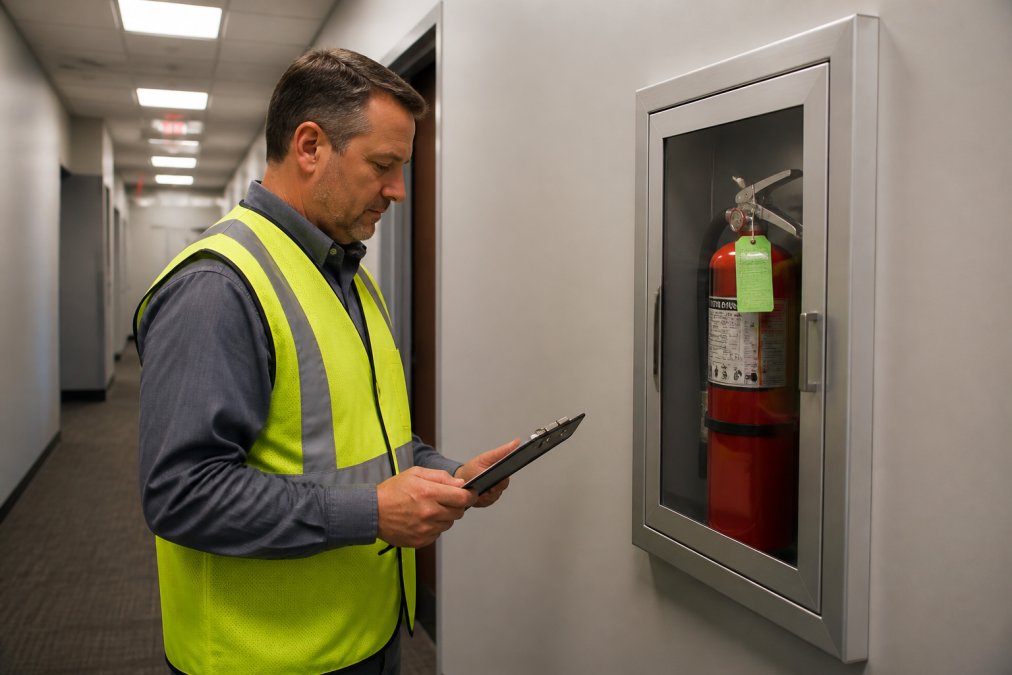
Cabinet selection follows the extinguisher, and the environment dictates material. The JL Industries Academy Series cabinet at $221.00 features clear anodized aluminum for lobbies and healthcare waiting areas; the Ambassador Series at $296.00 offers white powder-coated steel for industrial corridors or parking garages.


Semi-recessed cabinets suit drywall partitions; surface-mount cabinets are the only option for masonry or concrete. Always verify wall depth before ordering a recessed model.
Step 5: Document Your Rationale
When buying online, keep a written record of the hazard assessment behind each selection; inspectors and AHJs will ask why a particular agent was chosen for a specific area.
This hazard-based approach prevents the most common error: buying one extinguisher type for the entire building and hoping it covers every scenario.
Fire Protection Equipment Maintenance and Inspection Schedules
Fire protection equipment is not set-and-forget. NFPA 10 and OSHA impose specific, recurring obligations on the building owner or designated responsible party.
The Monthly Visual Inspection: What to Check in Under 2 Minutes
NFPA 10 Section 7.2.1 requires a monthly visual inspection of all portable extinguishers, a documented check taking under two minutes per unit. The checklist covers six points:
- Location and Accessibility: The extinguisher is in its designated place, not blocked by storage, carts, or debris. The travel path to it is unobstructed.
- Visibility and Signage: The unit is visible, or the location is clearly marked with an approved sign. For cabinets, the glass front is intact and not painted over.
- Pressure Gauge Reading: The needle is in the green operating range. For extinguishers without a gauge (e.g., some CO2 models), verify the weight against the stamped empty weight on the nameplate.
- Physical Condition: No visible corrosion, dents, leaks, or nozzle blockage. The safety pin is in place and the tamper seal is unbroken.
- Instruction Label Legibility: The operating instructions are readable and not faded or damaged.
- Mounting Integrity: The bracket or cabinet is secure, and the unit is not loose or at risk of falling.
A common inspection failure is the 'blocked unit' issue, inventory or a coat rack placed in front of an extinguisher.
The Annual Maintenance Inspection: What a Certified Professional Does
Once per year, NFPA 10 requires a more thorough maintenance inspection by a certified technician. The annual service includes:
- Internal Examination: For stored-pressure extinguishers, the technician checks the interior for corrosion, moisture, or agent clumping.
- Agent Verification: The chemical agent is checked for proper quantity and condition. Dry chemical that has packed or caked is replaced.
- Seal and Gasket Replacement: Seals and O-rings are replaced per the manufacturer's service manual.
- Hydrostatic Testing (on Schedule): Pressurized cylinders must undergo hydrostatic testing every 5, 12, or 15 years depending on the agent and cylinder type. The test date is stamped on the cylinder neck. A unit that fails this test must be taken out of service immediately.
- Recharge or Replacement: Any unit that has been discharged, even partially, must be recharged by a certified professional. A partially discharged extinguisher is not a partially working extinguisher; it is a failed unit.
The OSHA guidelines on fire extinguisher maintenance align with NFPA requirements and provide a clear reference for what employers must document. OSHA's general industry standard (29 CFR 1910.157) explicitly requires that extinguishers be maintained in a fully charged and operable condition, and that a visual inspection be conducted monthly.
Building a Tracking System That Prevents Lapses
For multi-property facility managers, a paper logbook is insufficient. A digital tracking system logging inspection dates, flagging upcoming maintenance, and storing service records is most effective. Build a simple spreadsheet tracker with these columns:
| Column | Purpose |
|---|---|
| Unit ID | Unique identifier (e.g., BLDG-A-FLR2-EXT-01) |
| Location | Exact mounting position |
| Agent Type | ABC, CO2, Class K, etc. |
| Manufacture Date | Stamped on the cylinder |
| Last Monthly Check | Date of the most recent visual inspection |
| Next Monthly Check | Auto-calculated 30 days out |
| Last Annual Service | Date of the certified maintenance |
| Next Annual Service | Auto-calculated 365 days out |
| Hydrostatic Test Due | Based on the cylinder type and manufacture date |
| Technician Name | Who performed the annual service |
The 6-Year and 12-Year Milestones You Cannot Miss
Two time-based requirements catch many facility managers off guard:
- 6-Year Internal Examination: NFPA 10 requires a complete internal examination of stored-pressure dry chemical extinguishers every 6 years. This involves emptying the agent, inspecting the interior, and recharging the unit. This is a separate requirement from the annual maintenance.
- 12-Year Hydrostatic Test: Most stored-pressure extinguishers must undergo hydrostatic testing every 12 years. The test date is stamped on the cylinder. Units that fail are condemned and must be replaced.
When buying online, request the manufacture date on each unit. Extinguishers have a finite service life, typically 12 years for stored-pressure models, after which they must be replaced, not recharged.
Downloadable Checklist for Your Team
Print a checklist for each extinguisher location and attach it to the cabinet or bracket, with spaces for the inspector's initials, date, and a checkbox for each of the six monthly points. This creates a physical audit trail satisfying most AHJ documentation requests.
A facility treating maintenance as a scheduled, documented process passes inspection without last-minute corrections.
Buy Fire Protection Equipment Online: Common Mistakes to Avoid
The most frequent mistake when buying fire protection equipment online is prioritizing price over compliance documentation. A cheaper extinguisher without clear UL certification or manufacturer submittals becomes a liability during inspection.
A second common error involves cabinet sizing: buyers measure the extinguisher but forget bracket depth or wall recess, resulting in a door that will not close or a unit protruding into the hallway. Always compare the cabinet's interior dimensions against the full installed depth of the extinguisher and bracket.
Third, many buyers overlook hazmat shipping fees; dry chemical extinguishers carry a surcharge that can add significant cost to a bulk order. Finally, do not assume all distributors carry the same inventory depth.
Build a Safer Facility with the Right Fire Protection Equipment
Fire protection is a system, not a collection of parts. The extinguisher, cabinet, alarm, and inspection schedule only work together when each component meets the applicable standard.
Victory Construction Products simplifies this by stocking extinguishers, cabinets, and related safety equipment from 15 trusted brands, with same-day shipping on most in-stock orders. Our lowest-price guarantee covers the Buckeye and JL Industries lines.
Selecting fire protection equipment for a commercial building carries responsibility beyond routine procurement. Compliance with NFPA and UL requirements protects occupants, property, and your professional reputation. Victory Construction Products offers in-stock inventory, rapid shipping, and documentation support to keep your projects on schedule and facilities inspection-ready. Add the fire protection equipment you need to your cart and build a safer facility today.
Frequently Asked Questions
What should I look for when buying fire protection equipment online?
Verify the equipment carries a UL listing and meets current NFPA fire safety compliance requirements for your building type. Check the manufacturer's data sheet for the extinguisher's rating, such as 4-A:60-B:C, and confirm it matches your hazard class. Review the distributor's return policy and shipping terms, especially for items like CO2 extinguishers that may incur hazmat fees.
How do I ensure fire protection equipment is UL-listed before buying?
Look for the UL mark printed on the product label or listed in the manufacturer's specification sheet. Reputable distributors like Victory Construction Products publish this information in the product description and submittal documents. If the listing is not visible, request the spec sheet before you order. The UL mark confirms the unit has been tested to recognized safety standards for its intended use.
What is the typical lead time for commercial-grade fire protection equipment?
Lead times vary by product and manufacturer. Many common items, including Buckeye ABC dry chemical extinguishers and JL Industries cabinets, ship the same day when they are in stock at a regional warehouse. Specialty items that must be sourced directly from the manufacturer may take several weeks. Ask the distributor about current stock status before you place your order to plan your project schedule.
How can I verify the authenticity of fire safety products purchased online?
Purchase from an authorized distributor rather than a third-party marketplace seller. Confirm the distributor represents the brands they sell and request submittal sheets that trace the product to the original manufacturer. Check the product for a UL mark and a serial number. Authorized distributors provide warranty support and can help you source the correct replacement parts.