
Table of Contents
- Why Contractors Choose Access Door Alternatives to Acudor
- Quick Comparison: Top Access Door Alternatives
- Best Access Door Brands for Contractors
- Fire-Rated Access Door Requirements and Compliance
- How to Choose the Right Access Panel for Your Project
- DIY vs. Professional Installation: Trade-Offs and Costs
- Common Installation Failures and How to Avoid Them
- Frequently Asked Questions
Last Updated: September 2, 2026
Why Contractors Choose Access Door Alternatives to Acudor
When managing time-sensitive commercial projects, supply chain delays and poor product fit create costly problems. Acudor has been an industry standard, but it's far from the only option, and often not the best for your specific application.
Access door selection comes down to three factors: building code requirements, budget, and installation timeline. Different manufacturers excel at different combinations. Some prioritize fire-rated compliance, others focus on durability in masonry applications, and a few specialize in anti-sag designs for horizontal surfaces.
At Victory Construction Products, we've spent 27 years distributing access hardware to contractors who can't afford mistakes. We stock 15 trusted brands because no single manufacturer dominates every scenario. This guide breaks down realistic alternatives to Acudor, shows how each performs in specific situations, and helps you decide based on actual project needs rather than brand familiarity.
Quick Comparison: Top Access Door Alternatives
| Brand | Starting Price | Best For | Key Advantage |
|---|---|---|---|
| JL Industries TM | $40.00 | General purpose, budget-conscious projects | Paintable, versatile flange coverage |
| Milcor M | $77.95 | Premium installations, accessibility | 100% clear opening, concealed hinges |
| Elmdor DW | $132.00 | Masonry and remodel work | Galvannealed steel, durability in tough environments |
| Cendrex AHD | $40.60 | Horizontal surfaces, anti-sag applications | Prevents sagging, fewer locks required |
| Acudor UF-5500 | $25.90 | Exterior and corrosive environments | Galvanized steel, baked polyester coating |
Best Access Door Brands for Contractors
Your choice of access door brand should reflect the specific demands of your installation. Each manufacturer has carved out a reputation for solving particular problems that matter to contractors in the field.

JL Industries TM: Budget-Friendly General Purpose
The JL Industries TM is a paintable access door designed for installation in wallboard, plaster, masonry, brick, or paneling. The 1-inch flange covers the cut opening cleanly and accommodates a wide variety of wall and ceiling installations for plumbing, HVAC, communications, and general utility access.
This door works best for straightforward access without specialized features. It's not fire-rated, so it won't work in applications requiring fire-resistance ratings. For standard commercial interiors where building codes don't mandate fire protection, the TM delivers reliable performance at the lowest entry point. The paintable surface lets contractors match existing finishes without special ordering or coordination delays.
Building code compliance standards for access panels vary by jurisdiction, but general-purpose doors like the TM satisfy non-rated requirements in most commercial applications. Installation is straightforward: cut your opening, secure the flange, and finish to match your wall or ceiling.
Many contractors appreciate the simplicity. There's no complex mechanism to fail, no specialized tools required, and no confusion about fit.
Milcor M: Premium Strength and Accessibility
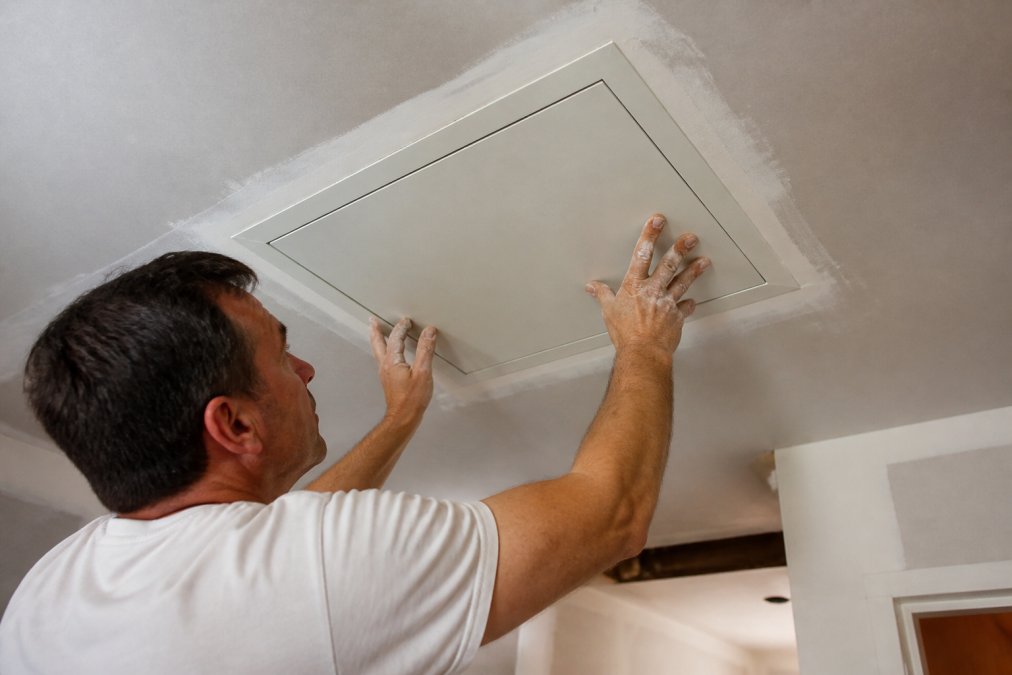
The Milcor M offers the opposite end of the spectrum. The 16-gauge one-piece frame provides 100% clear opening with superior strength and rigidity. The door panel mounts on concealed spring hinges that open to 175 degrees, allowing complete access without the door impacting the wall behind it.
The cam latch release mechanism moves the edge of the door panel outward, giving you a fingerhold for easy opening even when wearing gloves. This efficiency matters on job sites where workers move between tasks quickly.
Milcor doors cost roughly double what a basic TM costs, but the engineering justifies the price for applications where durability and accessibility matter. The concealed hinges and true square frame ensure consistent performance after years of use.
Elmdor DW: Durability for Masonry and Remodels
Elmdor DW doors excel in challenging applications: masonry, tile, wood, or other non-standard materials. The 16-gauge galvannealed steel construction with prime coat finish resists corrosion in environments where standard doors would deteriorate.
The rounded safety corners reduce liability exposure and prevent sharp edges that catch clothing during installation or maintenance. For facility managers overseeing properties with mixed construction materials, Elmdor DW provides consistent performance across diverse installations.
The galvannealed finish offers superior corrosion resistance compared to standard galvanized options. This is particularly valuable in mechanical rooms, basements, or any location with higher moisture exposure. The prime coat finish accepts paint well, allowing contractors to match existing surfaces without special preparation.
Cendrex AHD: Anti-Sag Design for Horizontal Surfaces
The Cendrex AHD addresses a specific problem: sagging on horizontal surfaces, particularly ceilings. A flat door panel gradually sags over time, especially in larger openings or with temperature fluctuations.
The AHD's rounded mitered corners and concealed pin hinge create a structural design that resists sagging. The 3/8-inch return all around the door adds rigidity that flat designs can't match. This means fewer service calls, fewer complaints about doors that won't close properly, and fewer maintenance callbacks.
The anti-sag design also reduces the number of locks required. A standard flat panel on a large horizontal opening might need two or three locks. The AHD typically needs just one, reducing installation time and moving parts that could fail. For contractors managing multiple properties or facility managers responsible for numerous commercial spaces, this efficiency compounds significantly.
Fire-Rated Access Door Requirements and Compliance
Fire-rated access doors serve a critical safety function. A fire-rated access door must maintain its integrity and prevent flame and smoke passage for a specified duration, typically 1 or 2 hours, depending on building code requirements for that location and use.
The National Fire Protection Association (NFPA) and International Building Code (IBC) fire-rated assembly standards establish testing protocols and performance requirements. A door tested to 1-hour fire rating has passed exposure to a standardized fire curve and proven it can contain fire and smoke for that duration without dangerous heat transfer (iccsafe.org).
When building codes require fire-rated access doors, which they do in most commercial applications where the door opens into a fire-rated wall or ceiling assembly, you cannot substitute a standard non-rated door. The consequences range from failed inspections and project delays to serious liability exposure if a fire occurs and the non-rated door fails.
Fire-rated doors are heavier, more expensive, and require more careful installation than general-purpose alternatives. The frame, door panel, and all hardware must be rated as a complete assembly. Substituting a hinge or latch from a different manufacturer can invalidate the fire rating.
How to Choose the Right Access Panel for Your Project
Your decision framework should address three core variables: the material composition of the surrounding surface, the mounting style for your installation, and the sizing requirements of your specific opening.
Material Type: Steel vs. Aluminum vs. Plastic
Steel access doors dominate commercial applications because they offer superior strength, durability, and fire-rated options. Steel resists impact, holds up in high-traffic areas, and accepts paint finishes that match existing surfaces. The trade-off is weight and cost.
Aluminum doors are lighter and resist corrosion naturally, making them suitable for exterior or marine applications. They're less common in interior commercial work because they don't offer the same structural integrity or fire-rating options as steel.
Plastic access doors are rare in commercial work but appear occasionally in utility applications where corrosion resistance is the primary concern. They lack the strength and fire-rating capability required for most building codes.
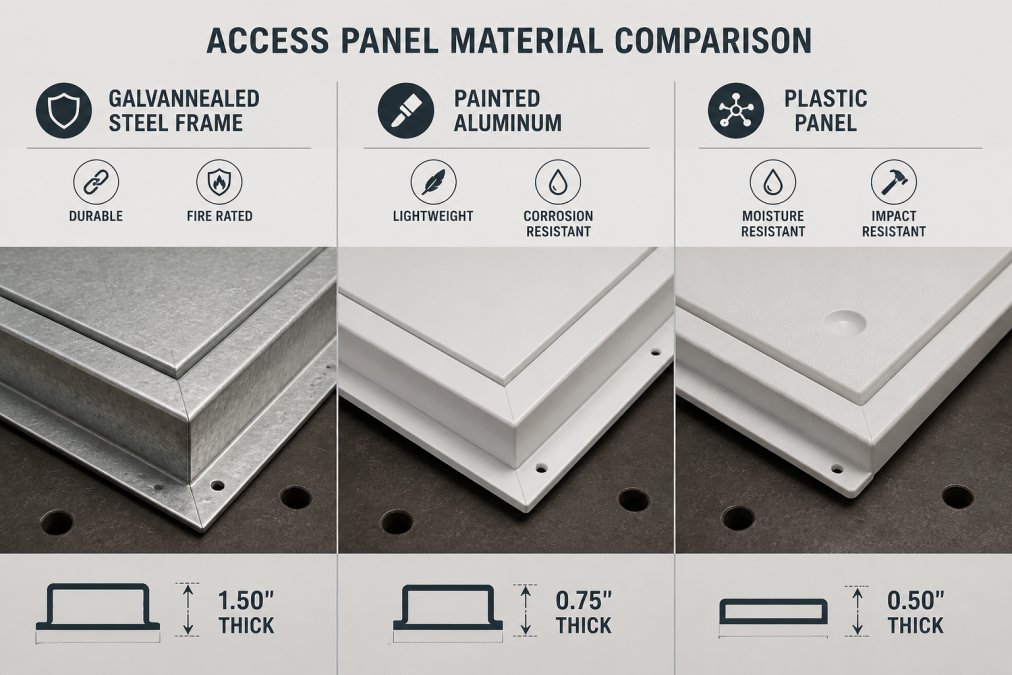
Steel is your default choice for commercial work. Choose aluminum only when corrosion resistance is the primary driver. Avoid plastic unless your specific application explicitly allows it and cost is the overriding factor.
Flush Mount vs. Surface Mount Installation
Flush-mount doors sit inside the wall or ceiling cavity, with only the flange visible on the finished surface. They integrate seamlessly with the surrounding material and are standard for new construction or remodels where the wall cavity is accessible during installation.
Surface-mount doors attach to the finished surface, with the entire frame visible. They're easier to install in retrofit situations where cutting into walls or ceilings isn't practical. The trade-off is aesthetic, surface-mount doors are more visible and less integrated.
For most commercial applications, flush-mount is superior. It looks cleaner, integrates better with finished spaces, and provides better protection for the mechanism. Surface-mount makes sense for retrofits or emergency repairs where you can't access the wall cavity.
Sizing and Standard Dimensions
Access doors come in standard sizes: 12x12, 18x18, 24x24, and 24x36 are most common. Larger openings are available but become expensive and require more structural consideration.
Measure your opening carefully. The door size refers to the clear opening. The flange extends beyond this opening, typically 1 to 3/8 inches on all sides, depending on the manufacturer. Your rough opening must accommodate both the door panel and the flange.
Custom sizing adds cost and lead time. Standard sizes ship quickly from in-stock inventory. If your project timeline is tight, standard sizes are your best option. Victory Construction Products maintains in-stock inventory across 11 warehouse locations, with same-day shipping on most orders.
DIY vs. Professional Installation: Trade-Offs and Costs
Installing an access door is straightforward enough that many contractors handle it themselves, but real trade-offs exist between DIY and professional installation.
DIY installation saves labor costs. For a standard flush-mount door in drywall, this is achievable for contractors with basic carpentry skills. You cut the opening to size, secure the flange, and finish the edges with drywall tape and joint compound.
Professional installation ensures consistent quality and catches mistakes before they become problems. A professional verifies that the opening is square, the flange sits flush with the finished surface, and the door operates smoothly. They also ensure fire-rated doors are installed according to manufacturer specifications, which is critical for maintaining the fire rating.
For fire-rated doors, professional installation is strongly recommended. The fire rating depends on correct installation of every component. A shortcut during installation can invalidate the rating, creating serious liability exposure if a fire occurs.
Common Installation Failures and How to Avoid Them
The most frequent installation mistakes fall into predictable categories.
Undersized openings are the most common error. Contractors measure the door size and assume that's the rough opening required. You need additional space for the flange. Verify the specific door's flange dimensions, typically 1 to 3/8 inches on all sides, before cutting.
Uneven flanges occur when the rough opening isn't square or the door isn't positioned correctly. This creates gaps that allow air and moisture to pass through. Use a level and measure diagonals to ensure the opening is square before installing.
Insufficient backing on horizontal installations causes sagging over time. The door panel needs structural support, particularly on ceilings. Ensure adequate framing behind the opening.
Incorrect fire-rated assembly happens when contractors substitute components or deviate from manufacturer's instructions. Fire-rated doors must be installed exactly as tested. Any deviation can invalidate the fire rating.
Poor finishing around the flange creates gaps that invite air infiltration and moisture. Drywall tape and joint compound should cover the flange transition smoothly. Take time to finish properly rather than rushing.
Neglected maintenance access occurs when doors are installed in inaccessible locations. Plan your installation location with future maintenance in mind.
Choosing the right access door alternative to Acudor depends on matching the product to your specific requirements: fire-rated vs. non-rated, material durability, installation timeline, and budget. Victory Construction Products stocks all of these alternatives in 11 warehouses across the country, with same-day shipping on most orders and a lowest-price guarantee. Whether you need a budget-friendly JL Industries TM for general purpose access or a premium Milcor M for high-traffic commercial spaces, we simplify your procurement with in-stock inventory, easy access to spec sheets and submittals, and reliable delivery that keeps your projects on schedule.

Frequently Asked Questions
Q: What is the difference between an access door and an access panel?
A: Access doors and access panels are often used interchangeably, but the distinction matters for your project. Access doors typically refer to hinged, swinging units with a latch mechanism for repeated access to utilities, HVAC systems, and plumbing. Access panels are usually smaller, removable covers that may not have hinges. Both provide service access and must meet building code compliance standards. The choice depends on frequency of use and installation surface type.
Q: Are fire-rated access door requirements mandatory for all commercial buildings?
A: Fire-rated access doors are required in specific building zones based on occupancy type and local fire codes. Buildings with fire-rated wall or ceiling assemblies must use fire-rated access doors to maintain structural integrity and safety standards. Non-rated doors in rated walls violate building code compliance and can result in failed inspections. Your architect or local building department can specify whether your project requires fire-rated panels. Most commercial construction uses at least some fire-rated doors in critical areas.
Q: How do I choose the right access panel for my project?
A: Start by identifying the installation surface: drywall, masonry, tile, or other material. Determine whether you need flush mount or surface mount design. Confirm the opening size and whether standard dimensions work or custom sizing is required. Check building codes for fire-rated requirements. Consider the material type (steel for durability, aluminum for corrosion resistance, plastic for budget projects). Verify latch mechanism type and whether tamper-resistant features are needed. Finally, match the aesthetic finish to your interior design requirements.
Q: What features should I look for in a high-quality access door alternative?
A: Quality access doors combine strength, ease of access, and durability. Look for 16-gauge steel construction for structural integrity, concealed hinges that open to at least 175 degrees for full access, and a cam latch mechanism for smooth operation. The frame should be drawn as one piece to prevent sagging and warping. Anti-corrosion coating and prime finish protect against moisture and environmental damage. Rounded safety corners and proper flange coverage ensure safe installation and finished appearance. These features prevent maintenance headaches and extend service life.
Q: How much do access door alternatives typically cost?
A: Access door pricing varies by brand, material, and size. Budget options like the Acudor UF-5500 start at $25.90, while mid-range doors like the JL Industries TM run $40.00 and the Cendrex AHD at $40.60. Premium options with enhanced durability, such as the Milcor M ($77.95) and Elmdor DW ($132.00), offer superior strength and longevity. Prices increase for fire-rated models and custom sizes. Victory Construction Products offers a lowest-price guarantee on all in-stock alternatives.
This article was written using GrandRanker