
Table of Contents
- Aluminum vs Steel Roof Hatches: Material Comparison Table
- Corrosion Resistance and Environmental Suitability
- Weight, Structural Load, and Load Capacity Requirements
- Material Strength, Durability, and Tensile Properties
- Thermal Conductivity, Thermal Bridging, and Energy Efficiency
- Commercial Roof Hatch Installation Best Practices and OSHA Safety Standards
- Cost Comparison, Lifecycle Analysis, and Maintenance Requirements
- Which Material Should You Choose for Your Commercial Building?
- Frequently Asked Questions
Last Updated: September 25, 2026
Aluminum vs Steel Roof Hatches: Material Comparison Table
When choosing between aluminum vs steel roof hatches for commercial buildings, the decision hinges on five critical factors: corrosion resistance, weight capacity, durability, thermal performance, and total cost of ownership. Both materials serve commercial applications effectively, but they excel in different environments and use cases.

Victory Construction Products stocks roof hatches in both materials from trusted manufacturers, giving facility managers and contractors immediate access to the right solution for their project requirements. The comparison table below provides a quick reference for the key differences.
| Factor | Aluminum Roof Hatches | Steel Roof Hatches | Winner |
|---|---|---|---|
| Corrosion Resistance | Excellent (naturally resistant) | Good (requires protective coating) | Aluminum |
| Weight Per Unit | Lighter (easier installation) | Heavier (requires more support) | Aluminum |
| Load Capacity | Moderate (suitable for most buildings) | Higher (industrial/heavy-duty) | Steel |
| Thermal Conductivity | Higher (more heat transfer) | Lower (better insulation) | Steel |
| Initial Cost | Higher upfront | Lower upfront | Steel |
| Lifecycle Cost | Lower (minimal maintenance) | Higher (coating maintenance) | Aluminum |
| Coastal Environment | Excellent | Requires galvanizing | Aluminum |
The table reveals a clear pattern: aluminum dominates in corrosion resistance and lifecycle economics, while steel wins in raw strength and thermal performance. Your choice depends on your building's location, roof loading requirements, and maintenance budget.
Corrosion Resistance and Environmental Suitability
Aluminum resists corrosion naturally through the formation of a protective oxide layer on its surface. This self-healing characteristic makes it the superior choice for coastal environments, humid climates, and buildings exposed to road salt or chemical spray.
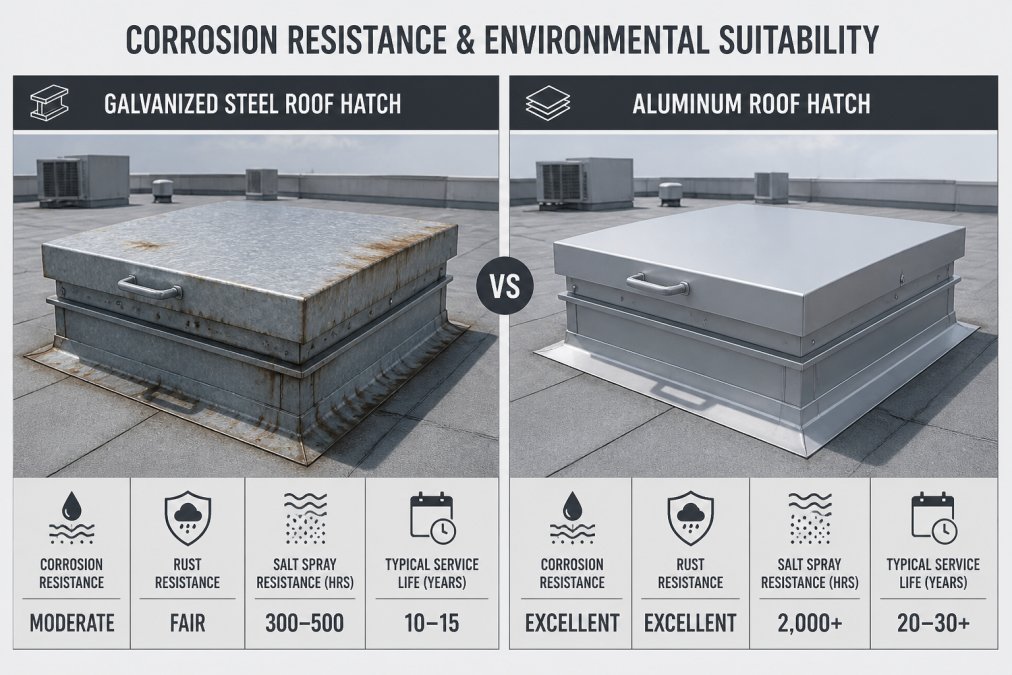
Steel, by contrast, requires protective coatings to prevent rust. Galvanized steel, where a zinc coating is applied to the steel substrate, offers strong corrosion resistance comparable to aluminum in many inland environments. However, the protective coating degrades over time, especially in harsh coastal or industrial settings. Once the coating is compromised, rust develops rapidly unless the hatch receives maintenance or recoating.
For facilities in coastal zones, industrial areas with airborne contaminants, or regions with high humidity and salt exposure, aluminum's natural corrosion resistance eliminates the need for ongoing protective maintenance. Steel remains viable in these environments only if the facility commits to regular coating inspection and reapplication every 5-10 years, depending on exposure severity.
The environmental suitability question often comes down to geography and maintenance philosophy. If your building faces harsh exposure and your maintenance budget is limited, aluminum delivers lower total cost of ownership. If your facility is inland with moderate exposure and you have reliable maintenance protocols, galvanized steel performs adequately at a lower initial purchase price.
Weight, Structural Load, and Load Capacity Requirements
Steel roof hatches are substantially heavier than aluminum equivalents, typically 40-60 pounds heavier for standard commercial sizes. This weight difference has direct implications for roof structure, installation labor, and building envelope integrity.
The structural load consideration matters most during installation. Heavier steel hatches require more rigorous roof framing to support the curb and frame assembly. Many commercial roofs, particularly those built to minimum code standards, have limited structural reserve capacity. A heavier hatch may require additional structural reinforcement, which adds cost and complexity to the installation process.
Aluminum's lighter weight simplifies installation and reduces the structural demands on the roof assembly. This becomes especially valuable in renovation projects where the existing roof structure may not accommodate a heavy steel unit without reinforcement. The weight savings also reduce strain on hinges, pivot mechanisms, and hold-open hardware over the hatch's operational life.
Load capacity, the weight the hatch opening can safely support when personnel are accessing the roof, is where steel claims superiority. Steel hatches typically support higher live loads on the roof opening itself. For buildings with frequent roof access by maintenance crews or equipment movement across the roof opening, steel's greater structural rigidity provides additional safety margin.
Most commercial buildings fall into a middle ground where either material meets code requirements. The choice becomes practical: if your roof structure is strong and your budget permits, steel's superior load capacity adds safety redundancy. If your roof framing is at design minimum or you're retrofitting an older building, aluminum's lighter weight may be the only practical option.
Material Strength, Durability, and Tensile Properties
Steel exhibits higher tensile strength than aluminum, roughly 2-3 times greater on a per-unit-area basis. This fundamental material property means steel can handle greater bending stresses and maintain structural integrity under extreme loading conditions. For buildings in heavy-wind zones or those requiring exceptional structural redundancy, steel's strength advantage translates to measurable safety benefits.
Aluminum's lower tensile strength does not mean it fails under normal commercial use. Modern aluminum alloys used in roof hatches are engineered to meet or exceed all applicable building codes and safety standards. The material's durability comes from its resistance to environmental degradation rather than from brute strength alone.
The practical durability comparison reveals a nuance: steel's strength is offset by its vulnerability to corrosion. A steel hatch in a corrosive environment gradually loses material thickness as rust develops, which actually reduces its effective strength over time. An aluminum hatch maintains its full cross-sectional area and structural properties indefinitely in the same environment.
This creates an interesting trade-off. Steel starts with higher tensile strength but loses that advantage as corrosion progresses. Aluminum starts with lower tensile strength but maintains it throughout its service life. In coastal or industrial environments, an aluminum hatch often ends up more durable than a steel hatch because the aluminum retains its properties while the steel's protective coating deteriorates.
For inland, low-corrosion environments, steel's durability advantage remains clear. The material simply lasts longer under moderate exposure conditions. For harsh environments, aluminum's maintenance-free durability wins the long-term comparison.
Thermal Conductivity, Thermal Bridging, and Energy Efficiency
Aluminum conducts heat roughly 3 times faster than steel. This higher thermal conductivity means aluminum hatches create a more significant thermal bridge through the roof assembly. During winter, heat escapes through the aluminum frame faster than through a steel frame. During summer, external heat conducts inward more readily.
This thermal bridging effect becomes measurable in buildings with strict energy performance requirements. Modern commercial buildings often target specific thermal resistance values (R-values) for the building envelope. A roof hatch opening in the envelope creates a weak point, and the material choice determines how weak that point becomes.

Steel's lower thermal conductivity reduces thermal bridging and helps maintain the roof assembly's overall insulation value.
Commercial Roof Hatch Installation Best Practices and OSHA Safety Standards
Installation quality determines whether aluminum vs steel roof hatches for commercial buildings deliver their intended service life and safety performance. Both materials require proper curb mounting, weather sealing, and hardware installation to function correctly.
Cost Comparison, Lifecycle Analysis, and Maintenance Requirements
The initial purchase price heavily favors steel. A standard steel roof hatch typically costs 15-25% less than an equivalent aluminum unit. For a facility manager budgeting for multiple roof access points, this upfront savings can be substantial.

Which Material Should You Choose for Your Commercial Building?
The answer depends on three variables: your building's environmental exposure, your maintenance capacity, and your budget structure.
Frequently Asked Questions
What are the primary durability differences between aluminum and steel roof hatches?
Steel roof hatches, when galvanized, offer exceptional strength and load-bearing capacity, making them suitable for high-traffic commercial roofs. Aluminum hatches are lighter and naturally corrosion-resistant without coatings, reducing maintenance. Steel requires protective coatings to prevent rust in coastal or wet environments, while aluminum's inherent resistance makes it maintenance-free in most conditions. For buildings in harsh climates, aluminum eliminates the need for periodic recoating that galvanized steel may require.
How does corrosion resistance compare between aluminum and steel hatches in coastal environments?
Aluminum naturally resists corrosion through oxide layer formation and performs exceptionally well in coastal salt-air environments without additional protective coatings. Galvanized steel can experience galvanic corrosion when exposed to salt spray and moisture, especially where dissimilar metals meet in hardware and hinges. In coastal applications, aluminum requires minimal maintenance, while galvanized steel hatches may need periodic inspection and touch-ups to prevent rust formation at fasteners and seams. Stainless steel options exist but cost significantly more than both materials.
Are there specific OSHA or building code requirements that dictate roof hatch material selection?
OSHA standards require roof hatches to meet structural integrity and safety requirements regardless of material, focusing on load capacity, weather-tightness, and safe operation. The International Building Code (IBC) specifies that roof access hatches must support live loads and resist wind uplift forces appropriate to the building's location and height. Material selection isn't mandated by code, but the chosen material must meet structural load requirements and maintain weather-tightness. Your building's geographic location, wind zone, and snow load requirements may influence whether aluminum or steel better meets these performance standards.
Which material offers better thermal performance for commercial roof access?
Aluminum conducts heat more readily than steel, which can create thermal bridging, a pathway for energy loss through the roof assembly. Steel, particularly when galvanized, has lower thermal conductivity and reduces thermal bridging effects. However, most commercial roof hatches include insulation in the lid, which minimizes the material's direct thermal impact. For buildings in cold climates prioritizing energy efficiency, steel's lower thermal conductivity is advantageous. In moderate climates, the insulation in the hatch lid is more significant than the frame material's thermal properties.
What is the cost difference between aluminum and steel roof hatches?
Victory Construction Products offers aluminum-capable hatches, such as the Acudor Roof Hatch starting at $966.00, and galvanized steel options like the Bilco Roof Hatch at $1,150.00 or the Elmdor Galvanized Steel Roof Hatch at $1,340.00. Lifecycle costs favor aluminum in coastal or wet environments where steel requires periodic maintenance and recoating. Steel hatches may offer better long-term value in inland, dry climates where corrosion risk is minimal. Consider total ownership cost over 20-30 years, including maintenance labor and coating replacement, not just initial purchase price.