
Table of Contents
- Steel vs Aluminum Access Doors: The Short Answer
- How Steel and Aluminum Compare at a Glance
- Corrosion Resistance of Aluminum Access Panels in Harsh Environments
- Fire-Rated Access Door Requirements: What Steel and Aluminum Can and Cannot Do
- Cost Comparison of Commercial Access Doors: Unit Price vs Lifecycle Spend
- Weight, Installation Labor, and Hardware Compatibility
- Matching Material to Application: A Selection Framework
- Frequently Asked Questions
Last Updated: September 15, 2026
Steel vs Aluminum Access Doors: The Short Answer
For most commercial interiors, aluminum wins on corrosion resistance and installation labor; steel wins on fire ratings, security, and price per unit. The steel vs aluminum decision for access doors comes down to four variables: where the door lives, what the wall or ceiling must do in a fire, how often it gets opened, and how long you plan to own the building. This guide from Victory Construction Products breaks down each variable so you can specify with confidence.
Aluminum access doors are built from extruded aluminum frames and panels, which makes them lighter and naturally resistant to rust. Steel access doors use galvanized or powder-coated steel, which delivers higher tensile strength and the structural integrity fire-rated assemblies demand.

A common mistake is defaulting to steel everywhere because it "feels stronger." In practice, that instinct adds weight, labor, and corrosion risk in wet or coastal environments where aluminum performs better for decades with almost no maintenance.
Below, we'll walk through corrosion, fire ratings, lifecycle cost, and hardware compatibility, then give you a selection framework you can apply to your next submittal.
How Steel and Aluminum Compare at a Glance
The fastest way to choose between steel and aluminum access doors is to match material to environment and code requirement, not to habit. Aluminum suits exterior, wet, and corrosive settings; steel suits fire-rated and high-security interior applications.

| Factor | Aluminum | Steel |
|---|---|---|
| Corrosion resistance | Excellent, no rust | Requires coating or galvanizing |
| Weight | Roughly one-third of steel | Heavier, needs more labor |
| Fire rating capability | Limited | Rated assemblies available |
| Impact resistance | Moderate | High |
| Typical best use | Exterior, wet, coastal | Fire-rated walls, security |
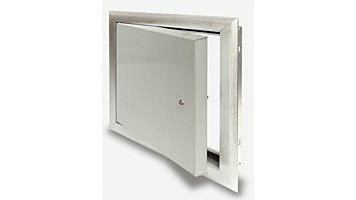
Aluminum's thermal conductivity also matters in insulated envelopes: an aluminum door panel with fiberglass or polystyrene insulation reduces air and sound transfer between partitions, which is why products like the Cendrex PAL Aluminum Access Door pair an all-aluminum body with a neoprene gasket. Steel, by contrast, brings the mass and rigidity that forced-entry resistance and fire-rated frames require.
Corrosion Resistance of Aluminum Access Panels in Harsh Environments
Aluminum access panels resist corrosion because the metal forms a natural oxide layer that reseals itself when scratched. That self-passivating behavior is why the corrosion resistance of aluminum access panels holds up in wastewater treatment plants, pool mechanical rooms, coastal facilities, and any space with constant moisture.
Steel needs help here. Galvanized steel relies on a zinc coating, and powder coating adds a second barrier, but every cut edge, scratch, and fastener hole is a potential starting point for rust. In high-humidity or chemical-exposure settings, that maintenance cycle never really ends.
A common mistake is specifying painted steel in a natatorium or treatment plant because it was cheaper at bid time, then repainting it every few years. The American Galvanizers Association corrosion guidance explains how coating durability varies by environment, and it's worth reading before you commit steel to a wet space.
Fire-Rated Access Door Requirements: What Steel and Aluminum Can and Cannot Do
Fire-rated access door requirements are driven by the assembly, not the door in isolation. A rated access door must carry a label whose rating matches the wall or ceiling it penetrates, typically 1, 1.5, or 3 hours, and it must be tested and listed as part of a recognized assembly (Fire Doors and NFPA 80 FAQs). That listing is what the inspector looks for: a label, a listing number, and a manufacturer's installation instructions that match the field condition.

This is where steel and aluminum part ways. Steel can be fabricated into rated assemblies because it retains structural integrity at the temperatures a fire test imposes. Rated steel doors typically use an intumescent gasket that expands under heat to seal the gap between door and frame, plus a self-closing or self-latching mechanism so the door returns to the closed position after each use. Aluminum's lower melting point limits its role in rated applications, so the overwhelming majority of fire-rated access doors you will specify are steel.
Rating hours are not interchangeable. A 1-hour door belongs in a 1-hour wall; putting a 1-hour door in a 2-hour corridor wall fails the assembly. The reverse, a 3-hour door in a 1-hour wall, is compliant but usually a waste of budget. Match the door label to the assembly rating stamped on the drawings, and confirm the frame is listed for the wall type (masonry, gypsum board, or shaft wall) because the same door may not be listed for every substrate.
Building codes enforced at the local level, generally through the International Code Council IBC overview, require that any penetration in a rated wall maintain the assembly's integrity. That means the access door, its frame, its fasteners, and its installation method are all part of the compliance picture. A door that is listed but installed with the wrong anchors or without the specified clearance is not a compliant installation.
A practical rule for submittals: if the wall or ceiling has a fire-resistance rating on the drawings, specify a labeled steel door with the matching hour rating and the listed frame for that substrate. If the wall is unrated, aluminum is back on the table and often the better choice for wet or exterior conditions. When in doubt, the door's listing document, not the sales sheet, is the authority.
Cost Comparison of Commercial Access Doors: Unit Price vs Lifecycle Spend
The cost comparison of commercial access doors looks very different depending on whether you're reading a bid sheet or a 20-year budget. Unit price favors steel; lifecycle cost often favors aluminum. Most published comparisons stop at the bid sheet. This one walks the full ownership period.
Start with the upfront line items. Aluminum doors typically carry a higher unit price than a comparable steel panel because of extrusion and finishing costs. Steel's raw material and fabrication are cheaper, so the bid sheet usually favors steel by a meaningful margin on a per-door basis. That is the number most estimators see, and it is the number that most often decides the specification.
Now add the costs the bid sheet omits. Four drivers dominate the 10- to 20-year picture:
- Installation labor. An aluminum door weighs roughly one-third of a comparable steel door. On a single door the difference is minutes; across a project with dozens of ceiling or overhead panels, the labor delta compounds, and it can eliminate the need for a lift on some installations.
- Coating maintenance. Painted or galvanized steel in a wet, humid, or chemically exposed space will need touch-up and eventual repainting. Each cycle carries material, prep, and labor. Aluminum's self-passivating oxide layer does not require that cycle in the same environments.
- Corrosion-driven replacement. Once rust reaches a steel frame or hinge pocket, the door is usually replaced rather than repaired.
| Scenario | Lower Upfront Cost | Lower Lifecycle Cost |
|---|---|---|
| Dry interior wall | Steel | Steel |
| Exterior or wet room | Steel | Aluminum |
| Fire-rated assembly | Steel | Steel |
| Coastal or chemical exposure | Steel | Aluminum |
Weight, Installation Labor, and Hardware Compatibility
Matching Material to Application: A Selection Framework
Frequently Asked Questions
Are steel access doors more durable than aluminum?
Steel access doors typically have higher tensile strength and impact resistance, making them a better fit for high-traffic areas and security-sensitive openings. Aluminum panels weigh roughly a third as much as steel of the same size, so they resist impact less but hold up well when the frame and hinges are sized correctly. For most commercial walls and ceilings, both materials deliver years of service if the gauge and mounting match the application.
When should you choose an aluminum access door over steel?
Choose aluminum when corrosion resistance matters most: wastewater treatment plants, food processing rooms, coastal buildings, and any exterior wall or ceiling exposed to moisture. Aluminum forms a protective oxide layer and needs no paint to resist rust. It also suits large openings where lightweight panels reduce installation labor. Products like the Cendrex PAL and Acudor LT-4000 are built for exactly these conditions.
Do fire-rated access doors require specific materials?
Fire-rated access doors must pass the test standard listed on the label, and that rating comes from the assembly, not the raw metal. Steel panels are common in fire-rated applications because they hold their shape under heat, but rated aluminum assemblies exist too. Always match the door's fire rating to the wall or ceiling it sits in, and confirm the listing covers the orientation and size you are installing.
How does the cost of steel compare to aluminum for access doors?
Aluminum panels usually carry a higher unit price than comparable steel panels, but the gap narrows when you factor in finishing, shipping, and installation labor. Aluminum arrives ready to install with no painting needed and weighs less, which cuts handling time on large openings. Steel costs less upfront and can be powder coated for exterior use, but that coating adds a step and a maintenance cycle over the door's service life.