
Table of Contents
- Why Roof Hatch Security Locks Matter for Commercial Buildings
- Types of Commercial Roof Hatch Locks and Latches
- Commercial Roof Hatch Locks: Materials and Durability
- Keyed Roof Hatch Lock Options and Compatibility
- Roof Hatch Latch Replacement: When and How
- Security, Code Compliance, and Forced-Entry Resistance
- Roof Hatch Models and Lock Options at Victory Construction Products
- Selection Criteria: Matching Locks to Your Building Profile
- Frequently Asked Questions
Last Updated: October 9, 2026
Why Roof Hatch Security Locks Matter for Commercial Buildings
Roof access is essential for maintenance, repairs, and inspections on commercial buildings. But uncontrolled access creates serious problems: unauthorized entry, liability exposure, weather damage, and security breaches. This is where roof hatch security locks become critical to your facility management strategy.

A roof hatch security lock isn't just a convenience feature, it's a safeguard that controls who can access your roof, when, and under what conditions. For facility managers, contractors, and procurement officers, choosing the right lock mechanism directly impacts both safety compliance and operational efficiency.
At Victory Construction Products, we've spent over 27 years sourcing and distributing commercial access hardware from trusted manufacturers. This guide breaks down roof hatch security locks by type, material, durability, and use case, so you can match the right lock to your building profile without guesswork.
Types of Commercial Roof Hatch Locks and Latches
Commercial roof hatches use several distinct locking mechanisms, each designed for different security levels and operational needs.
Keyed Locks and Padlock Systems
Keyed locks provide controlled access by restricting entry to authorized personnel who hold a key, the standard for buildings where roof access must be limited to maintenance staff, facility managers, or contractors with explicit permission.
Keyed systems fall into two categories: integral keyed locks built into the hatch frame, and external padlock provisions where you add your own padlock to a hasp or latch point. Integral locks are more secure because they're factory-installed and harder to defeat; external padlock systems offer flexibility, letting you change the lock type or key management without replacing the entire hatch.
The trade-off: integral keyed locks cost more upfront but provide seamless security, while padlock systems are cheaper and adaptable but depend on your padlock quality and key management process.
Internal Locking Handles and Sliding Bolts
Internal locking handles allow someone inside the building to secure the hatch from below, preventing it from being opened from the roof, essential where roof access should be possible only during scheduled maintenance windows or when a facility manager is present.
Sliding bolts (also called shoe bolts) slide horizontally to lock the hatch lid closed. They're often paired with external handles so the hatch can be operated and secured from both sides, giving you operational flexibility: you control access from inside the building without going to the roof to lock it.
Many commercial hatches combine methods: an internal locking handle for day-to-day security, plus a keyed lock for protection when the building is unoccupied.
Commercial Roof Hatch Locks: Materials and Durability
The material of your roof hatch security lock affects how long it lasts, how well it resists corrosion, and how much maintenance it requires.

Galvanized steel is the industry standard: affordable, strong, and rust-resistant through a zinc coating.
Aluminum alloy locks are lighter and naturally corrosion-resistant, ideal for salt-air environments or extreme weather exposure. They cost more than galvanized steel but eliminate rust concerns and reduce maintenance.
Stainless steel offers the highest corrosion resistance and durability but is the most expensive, typically reserved for harsh environments, coastal areas, chemical processing plants, or buildings where downtime is costly.
For most commercial buildings, galvanized steel locks deliver the best balance of cost and longevity.
Weatherproofing matters equally. Look for locks paired with rubber gaskets and sealing strips that keep rain, dust, and debris out of the hatch frame.
Keyed Roof Hatch Lock Options and Compatibility
When selecting a keyed roof hatch lock, compatibility with your existing hatch frame is non-negotiable. A lock that doesn't fit is useless, and retrofitting an incompatible system costs time and money.

Most commercial roof hatches accept standard keyed locks from the manufacturer. Bilco, Acudor, Dur-Red, Elmdor, and JL Industries all produce hatches with integrated lock provisions. If upgrading an existing hatch, verify the manufacturer and model before ordering a replacement lock.
Retrofit installations, adding a lock to a hatch that didn't originally have one, require more planning.
Key management is another consideration. If managing multiple buildings, decide whether to key all hatches alike (one master key opens every hatch) or differently (each building has its own system).
Roof Hatch Latch Replacement: When and How
Roof hatch latches wear out from repeated use, weather exposure, and corrosion. Knowing when to replace a latch, and how to do it safely, keeps roof access functioning reliably.
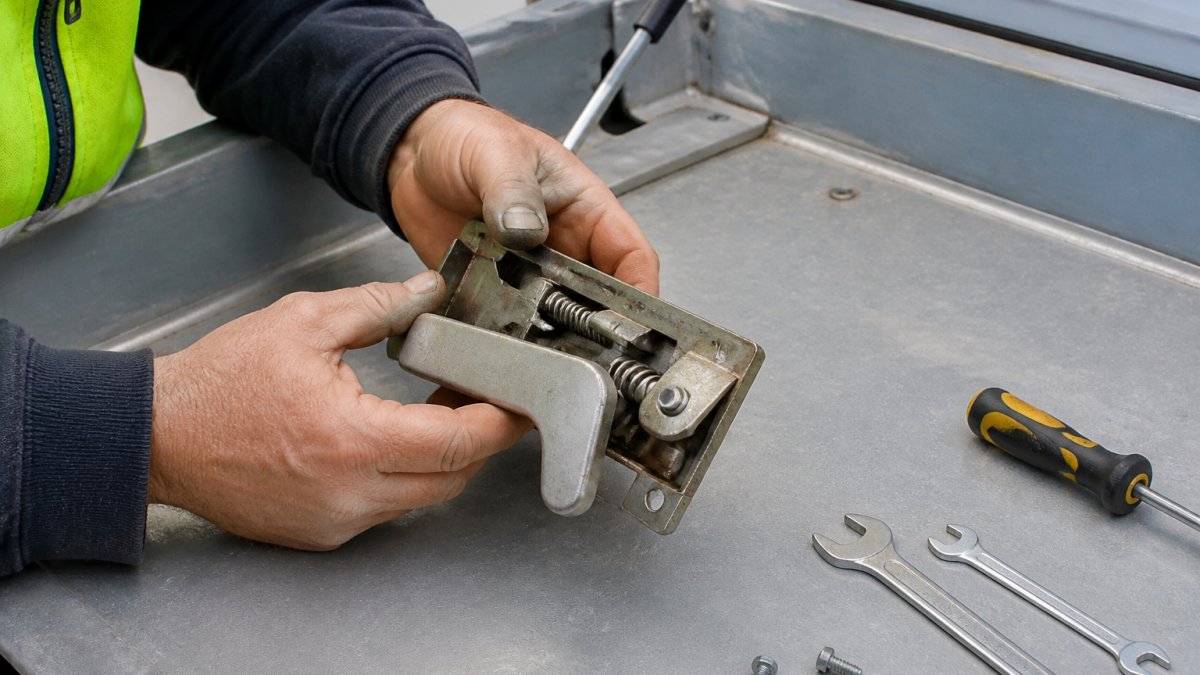
Signs your latch needs replacement:
- The latch won't hold the hatch closed, or it pops open unexpectedly
- The locking handle is stiff, cracked, or broken
- You see rust or corrosion on the latch mechanism
- The hatch lid sags or sits unevenly when closed
- The key no longer turns smoothly in a keyed lock
Replacement is straightforward for most commercial hatches. The latch assembly is bolted to the frame from inside the hatch.
The process: climb inside the hatch from below, unbolt the old latch assembly, remove it, and install the new one. Most replacements take 30 minutes to an hour.
If you're uncomfortable working at height or the existing latch is corroded and stuck, hire a contractor. A poorly installed latch creates safety hazards and wastes money on future repairs.
Security, Code Compliance, and Forced-Entry Resistance
Building codes regulate roof hatch access for safety and fire-egress reasons. Requirements vary by jurisdiction and building type, but generally address three concerns: how easily the hatch opens from inside in an emergency, how securely it locks against unauthorized access, and whether it meets fire-rating standards.
Fire-rated roof hatches must open quickly by occupants during an emergency, even if the lock is engaged, so the locking mechanism cannot require a key to exit. Internal locking handles satisfy this because they can be released from inside.
Forced-entry resistance prevents unauthorized access from outside. A simple padlock can be cut with bolt cutters in seconds; a keyed integral lock is harder to defeat but not impossible.
Most commercial roof hatches are not designed to withstand a determined attack; they deter casual trespassers and control access during normal operations.
Roof Hatch Models and Lock Options at Victory Construction Products
We carry five trusted roof hatch models, each with different lock configurations and price points. Here's how they compare.
Bilco Roof Hatch: One-Hand Operation and Secure Access
The Bilco Roof Hatch is engineered for one-hand operation: the lid opens fully in a single smooth motion, keeping one hand on the ladder. This reduces fall risk, making it popular where safety is paramount.
Bilco hatches come in galvanized steel, aluminum, or stainless steel. The locking mechanism is integral to the frame for secure keyed access, and the hatch is fully welded and ground smooth for weather tightness with a rubber gasket seal.
At $1,150.00, this is our premium option for contractors and facility managers who prioritize safety and durability over cost. If your building has high roof foot traffic or fall prevention is a compliance requirement, Bilco delivers.
Acudor Roof Hatch: Economical Security and Durability
The Acudor Roof Hatch balances cost and functionality, designed for convenient, economical roof access in prime-coated galvanized steel or aluminum. It prioritizes safety, durability, and ease of operation without premium pricing.
Acudor hatches include locking provisions and withstand regular use, a solid choice for smaller commercial buildings, warehouses, and facilities where roof access is occasional. At $966.00, they're mid-range in price and performance.
Note: Acudor hatches ship via freight due to size, so factor shipping costs into your budget.
Dur-Red Roof Hatch: Heavy-Duty Locking and Weather Protection
The Dur-Red Roof Hatch is built for demanding environments. The curb and frame are 14-gauge galvanized steel or aluminum, fully welded and ground smooth for absolute weather tightness, with heavy-duty 3/16" galvanized pivot hinges, fiberglass insulation in the lid, and a 22-gauge lid liner.
The locking system is strong: inside and outside handles with padlocking provisions, plus heavy-duty air-flow pressure intensifier control and automatic hold-open arms. This suits buildings exposed to extreme weather, high wind loads, or frequent maintenance access.
At $757.00, Dur-Red offers exceptional value for heavy-duty applications. If your roof faces constant weather exposure or rough treatment, this is our recommendation.
Elmdor and JL Industries: Cost-Effective Access Solutions
The Elmdor Galvanized Steel Roof Hatch ($960.00) and JL Industries Roof Hatch ($925.00) are our most budget-conscious options without sacrificing core functionality.
Elmdor hatches are engineered for durability and safety with straightforward installation, securing from the base flange. They're ideal for contractors managing multiple projects with tight budgets.
JL Industries offers similar functionality at the lowest price point. Both suit basic roof access where premium features aren't required.
| Hatch Model | Starting Price | Best For | Key Feature |
|---|---|---|---|
| Bilco | $1,150.00 | Safety-critical, high-traffic roofs | One-hand operation, premium materials |
| Acudor | $966.00 | Mid-range commercial buildings | Balanced cost and durability |
| Dur-Red | $757.00 | Extreme weather, heavy-duty use | Weather tightness, strong locking |
| Elmdor | $960.00 | Budget-conscious installations | Easy installation, solid durability |
| JL Industries | $925.00 | Basic roof access | Lowest cost option |
Selection Criteria: Matching Locks to Your Building Profile
Choosing the right roof hatch security lock depends on five factors: building type, roof access frequency, security requirements, climate exposure, and budget.
Access Frequency: Daily-use hatches need durable mechanisms; quarterly-access hatches can use simpler locks. High-frequency access argues for one-hand operation (like Bilco) to reduce fatigue and fall risk.
Security Requirements: A retail building with no sensitive roof equipment needs basic locking. A facility housing servers, HVAC controls, or hazardous materials needs stronger security.
Climate Exposure: Coastal and heavy-rain regions demand corrosion-resistant materials (aluminum or stainless steel) and excellent sealing; dry climates allow galvanized steel.
Budget: Your budget determines whether you invest in premium options like Bilco or prioritize cost-effective models like JL Industries.
Start by identifying your building's primary constraint: safety, security, weather resistance, or cost. That narrows the field quickly.
Choosing the right roof hatch security lock is about matching hardware to your building's actual needs, not buying the most or least expensive option. At Victory Construction Products, we stock five trusted models with different lock configurations and price points, backed by 27 years of industry experience and our lowest-price guarantee. Browse our roof hatch selection to find the right fit, and take advantage of same-day shipping from our 11 warehouse locations to keep your timeline on track.
Frequently Asked Questions
What types of locks work best for roof hatch security locks?
Roof hatch security locks come in three main types: keyed padlocks, internal locking handles, and sliding bolts. Keyed locks offer portability and are easy to inspect, while internal locking handles provide hands-free operation and are ideal for frequent access. Sliding bolts work well for less-trafficked roofs. Choose based on access frequency, weather exposure, and whether you need one-hand operation for safety compliance.
Can you add a keyed roof hatch lock to an existing hatch?
Yes, most commercial roof hatches can accept keyed locks as retrofit upgrades. Many models, including those from Dur-Red and Acudor, include padlocking provisions built into the frame and lid. Before purchasing, verify that your existing hatch frame has mounting points for a padlock hasp or that the lid has a keyed lock slot. If unsure, contact Victory Construction Products with your hatch model number for compatibility confirmation.
How do roof hatch latch replacement and maintenance affect security?
Regular inspection and timely roof hatch latch replacement are critical for security. Worn latches weaken the seal and reduce forced-entry resistance, allowing unauthorized access. Inspect latches annually for corrosion, rust, or mechanical wear, especially in coastal or high-moisture areas. Replace latches that no longer close firmly or show visible damage. Maintenance costs are typically lower than addressing a security breach or weather damage from a failed seal.
What building codes apply to roof hatch locks and egress?
Roof hatches used for emergency egress must comply with local building codes and OSHA requirements for fall protection and safe access. Most codes require that emergency exit hatches remain unlocked from the inside during occupancy, while security locks can be used on non-egress roof hatches. Check your local building department and fire marshal for specific requirements, as codes vary by jurisdiction and building type. Fire-rated hatches have additional locking restrictions.