
Table of Contents
- Industrial Access Hardware Alternatives: What You Need to Know
- Access Hardware Comparison Table
- Best Practices for Construction Hardware Sourcing
- Commercial Access Door Suppliers: Selection Criteria
- Access Hardware Lead Time Reduction Strategies
- Load Rating and Application Matching
- Total Cost of Ownership Analysis for Access Hardware
- Frequently Asked Questions
Last Updated: September 19, 2026
Industrial Access Hardware Alternatives: What You Need to Know
Sourcing the right industrial access hardware alternatives across multiple sites is critical, the wrong choice delays projects and strains budgets; the right choice keeps work on schedule.
This guide breaks down how to match hardware to your application, compare options by total cost of ownership, and reduce lead time delays that kill project timelines.
The core challenge is matching hardware to your specific needs. Load ratings, frame construction, material durability, and installation requirements all shift the equation, understanding these trade-offs separates smooth projects from stalled ones.
Access Hardware Comparison Table
| Product | Frame Type | Load Rating | Starting Price | Best For |
|---|---|---|---|---|
| Halliday S1R | Angle Frame | 300 lb/psf | $1,655 | Economical vault access, submersible pump installations |
| Acudor FA-300 | Angle Frame | 300 lb/psf | $2,542 | Interior/exterior applications without water intrusion requirements |
| Bilco Type J | Channel Frame | Pedestrian | $1,960 | Standard floor access, reinforced pedestrian loading |
| Halliday S1S | Angle Frame | 300 lb/psf | $2,320 | Vault access with lift assist and slam lock features |
| Halliday H2R | Angle Frame | H-20 Loading | $7,580 | Heavy traffic areas, off-street vault locations |
The Halliday S1R offers economical entry for applications without lift assistance. The Acudor FA-300 serves interior/exterior deployment without water-tightness demands. The Bilco Type J handles standard pedestrian loading. The Halliday S1S and H2R provide powered access and heavy vehicle loading capacity.

Best Practices for Construction Hardware Sourcing
Define load requirements before sourcing. Pedestrian-only access, light vehicle traffic, and heavy truck loading each demand different ratings. A 300 lb/psf rating handles most standard applications; H-20 loading is essential near roadways or with regular vehicle traffic. Confusing these requirements causes costly mistakes.
Evaluate frame construction carefully. Angle frame designs offer economical solutions for vault and submersible pump installations; channel frame construction suits pedestrian-focused access. Frame choice affects installation complexity, durability, and maintenance.
Material selection affects long-term costs. Aluminum reduces weight and installation complexity; zinc-plated hardware resists corrosion better than mill finish. Getting these details right early prevents expensive retrofits.
Commercial Access Door Suppliers: Selection Criteria
Suppliers differ in lead times, pricing consistency, technical support, and ability to guide retrofits of legacy hardware with modern alternatives.
Inventory Depth and Regional Availability
Evaluate inventory depth. A supplier stocking multiple manufacturers across load ratings and frame types fulfills urgent requests without special orders. Same-day shipping capability matters when timelines depend on hardware arriving within days, not weeks.
Regional warehouse proximity matters more than national reach. A supplier with distributed inventory near your facilities becomes a strategic advantage. Ask prospective suppliers for warehouse locations and average ship times to your primary areas.
Technical Documentation and Retrofit Support
Verify your supplier can provide technical documentation quickly and support retrofitting decisions. When replacing legacy hardware, you need a supplier who understands retrofit challenges, existing floor openings may require structural modifications. A supplier experienced in retrofits identifies conflicts before installation begins, preventing costly field modifications.
Ask prospective suppliers if they can assess whether existing floor openings accommodate modern hardware or require structural modifications. A supplier who can review facility drawings adds real value.
Pricing Transparency and Volume Arrangements
Pricing transparency separates professional suppliers from commodity vendors. Request a volume pricing schedule that locks rates for 12 months across typical hardware purchases, eliminating mid-year surprises and simplifying budget forecasting.
For facility managers overseeing multiple properties, negotiate a dedicated account manager and standing orders or pre-positioned inventory programs that guarantee availability and include volume discounts.
Halliday Products S1R Aluminum Angle →
Retrofit and Installation Expertise
Ask prospective suppliers about retrofit experience and references from similar projects.
Compliance and Documentation Support
Access Hardware Lead Time Reduction Strategies
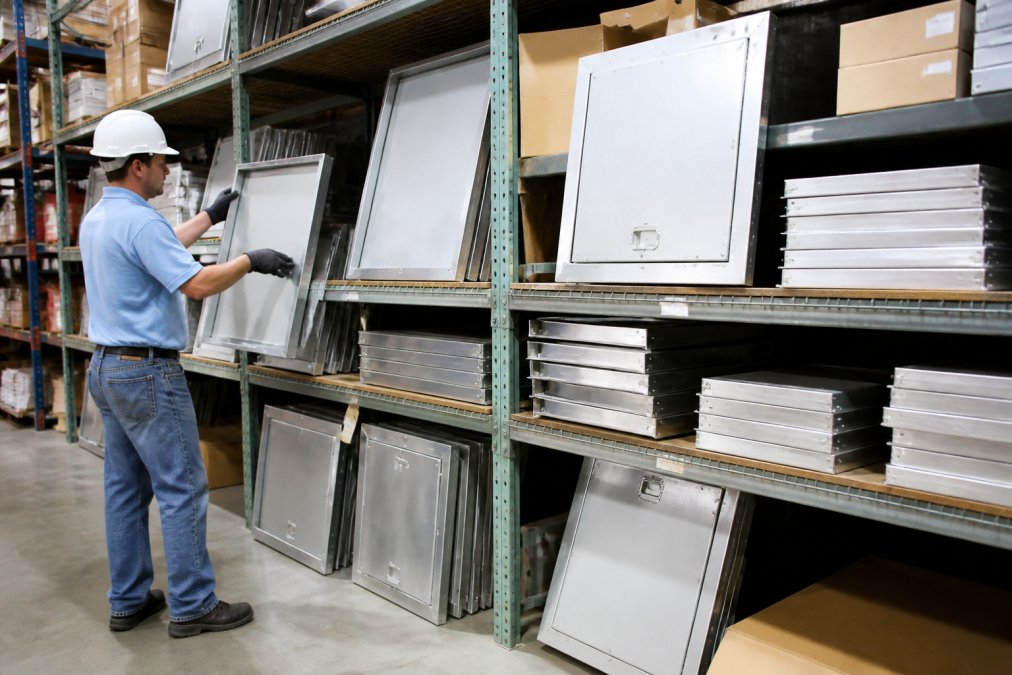
Lead time delays kill project schedules. Work with a supplier maintaining genuine warehouse inventory near your location. Same-day or next-day shipping becomes possible only when stock physically exists in a nearby warehouse.
Load Rating and Application Matching
Getting load rating right is non-negotiable. Undersized hardware fails under load. Oversized hardware wastes budget on unnecessary engineering. Matching the rating to the actual application is where precision engineering meets practical economics.
Total Cost of Ownership Analysis for Access Hardware
Purchase price is only one component of total cost. Installation complexity, maintenance requirements, replacement frequency, and operational disruption all factor into what hardware actually costs your organization over its lifespan. A structured TCO analysis reveals which hardware alternatives deliver the lowest true cost, not just the lowest sticker price.
Breaking Down the TCO Components
TCO Comparison Framework
- List your candidate hardware options (e.g., Halliday S1R, Acudor FA-300, Bilco Type J).
- Enter acquisition cost for each option.
- Calculate installation labor based on frame type, anchor requirements, and your regional labor rates.
- Estimate annual maintenance cost based on material and finish (aluminum, zinc-plated steel, mill finish).
- Project replacement frequency based on application environment (dry interior, exterior, high-traffic).
- Multiply maintenance cost by expected lifespan to get total maintenance expense.
- Add all components to reach total 10-year or 15-year cost.
- Divide by expected lifespan to get annualized cost, which simplifies comparison across different replacement cycles.
Real-World TCO Example
Option A: Halliday S1R (Angle Frame, Mill Finish)
- Acquisition: $1,655 × 20 = $33,100
- Installation labor: 6 hours × $100/hour × 20 = $12,000
- Annual maintenance: $75 × 20 = $1,500 annually
- 15-year maintenance total: $1,500 × 15 = $22,500
- Expected replacement at year 10: $33,100
- 15-year TCO: $100,700 ($6,713 annualized)
Option B: Acudor FA-300 (Angle Frame, Zinc-Plated)
- Acquisition: $2,542 × 20 = $50,840
- Installation labor: 3 hours × $100/hour × 20 = $6,000
- Annual maintenance: $40 × 20 = $800 annually
- 15-year maintenance total: $800 × 15 = $12,000
- Expected replacement at year 15: $0 (lasts full cycle)
- 15-year TCO: $68,840 ($4,589 annualized)
Applying TCO to Your Portfolio
Frequently Asked Questions
What are the most reliable brands for commercial access hardware?
Halliday Products and Bilco are two trusted manufacturers of industrial access hardware with proven durability in commercial applications. Halliday offers both economical and heavy-duty options, including the S1R Series ($1,655) for standard applications and the H2R Series ($7,580) for H-20 loading. Bilco's Type J Floor Hatch ($1,960) features reinforced composite spring tubes and heavy forged brass hinges. Acudor's FA-300 Series ($2,542) provides aluminum construction for interior and exterior use. Selecting among these depends on your load rating requirements and budget constraints.
How do I choose the right industrial access hardware for my project?
Match your hardware to three factors: load rating, installation environment, and water intrusion risk. For standard pedestrian loading (300 lb. psf), the Halliday S1R or Bilco Type J work well. For heavy vehicular traffic near roadways, choose H-20 rated hardware like the Halliday H2R. If water intrusion is a concern, avoid angle-frame designs; consult channel-frame alternatives. Consider whether you need lift assist (the S1S includes spring assists and slam lock) or prefer manual operation. Verify concrete casting requirements during the specification phase to avoid costly retrofits.
What is the importance of same-day shipping in construction hardware procurement?
Same-day shipping directly reduces project delays and keeps schedules on track. When access hardware arrives when promised, crews can proceed without waiting for materials, avoiding costly labor idle time and subcontractor conflicts. Distributors with multiple warehouse locations across different states can fulfill orders faster than single-location suppliers. For time-sensitive projects, verify that your supplier maintains actual inventory in nearby warehouses rather than drop-shipping from distant facilities. This capability becomes critical when specifications change mid-project or when unexpected hardware failures require emergency replacements.
How does a lowest-price guarantee impact construction procurement costs?
A lowest-price guarantee removes the uncertainty from competitive shopping and simplifies procurement decisions. Rather than spending hours comparing quotes across multiple distributors, contractors can order confidently knowing they're getting market-rate pricing. This saves procurement time and reduces administrative overhead. For facility managers overseeing bulk orders across multiple properties, a price guarantee provides budget predictability and eliminates the risk of overpaying for standardized hardware. When combined with same-day shipping and in-stock availability, a lowest-price guarantee delivers total cost savings beyond the unit price alone.
What factors should I consider when comparing industrial hardware suppliers?
Evaluate suppliers on five dimensions: inventory depth (do they stock multiple brands and load ratings?), geographic reach (how many warehouses serve your region?), lead time (same-day shipping vs. standard delivery), price transparency (guaranteed lowest price or variable quotes?), and technical support (can they provide submittals and spec sheets directly?). For large facility portfolios, confirm the supplier can handle bulk orders and generate consolidated invoicing across multiple projects. Verify that their online ordering system integrates with your procurement workflow to reduce manual data entry and order errors. References from other contractors in your region reveal real-world delivery performance.