
Quick Summary
A replacement cycle is a planned interval for swapping out fire protection equipment, even when it looks fine. Intervals depend on manufacturer recommendations, applicable requirements, and inspection findings, and extinguishers follow the most granular schedule. Use the table's figures as planning benchmarks, not substitutes for the data plate or AHJ requirements.
- Monthly visual inspection, annual maintenance, hydrostatic testing, and replacement are four separate obligations.
- Only hydrostatic testing and replacement retire an extinguisher cylinder.
- Rechargeable dry chemical extinguishers have a 12-year interval from manufacture date.
- Replace any extinguisher after a failed hydrostatic test, corrosion, or unknown discharge history.
- Fire alarm batteries are typically replaced every 3 to 5 years.
Table of Contents
- Why Replacement Cycles Matter for Fire Protection Equipment
- Replacement Cycle Table by Equipment Type
- Fire Extinguisher Replacement Schedule
- Fire Alarm System Replacement Guidelines
- Signs Fire Protection Equipment Needs Replacement
- Repair Versus Replace: Lifecycle Cost Decisions
- Building an Inspection Checklist and Maintenance Log
- Planning Your Next Equipment Replacement Cycle
- Frequently Asked Questions
Why Replacement Cycles Matter for Fire Protection Equipment
A replacement cycle, the planned interval at which equipment is swapped out regardless of whether it looks fine, can help organize equipment planning.
For general contractors and facility managers, a replacement cycle can be part of equipment planning.
Replacement intervals can depend on manufacturer recommendations, applicable requirements, and inspection findings.
Replacement Cycle Table by Equipment Type
The table below summarizes typical replacement intervals by equipment type. Treat these as planning benchmarks, not substitutes for the manufacturer's data plate or your AHJ's requirements.
| Equipment | Typical Replacement Interval | Primary Trigger |
|---|---|---|
| Rechargeable dry chemical extinguisher | 12 years from manufacture date, or per hydrostatic test | Hydrostatic test failure, age |
| Disposable extinguisher | Replace after any discharge or at end of rated life | Discharge, damage, expired gauge |
| CO2 extinguisher | Per hydrostatic test schedule | Hydrostatic test failure, weight loss |
| Smoke and heat detectors | Often 10 years from manufacture | Age, failed sensitivity test |
| Fire alarm control panel | Plan 15 to 20 years | Obsolete parts, failed upgrades |
| Sprinkler heads | Often 50 years, with sampling per NFPA 25 | Corrosion, sampling test results |
| Fire alarm batteries | Typically 3 to 5 years | Low-voltage alarms, failed load test |
Fire Extinguisher Replacement Schedule
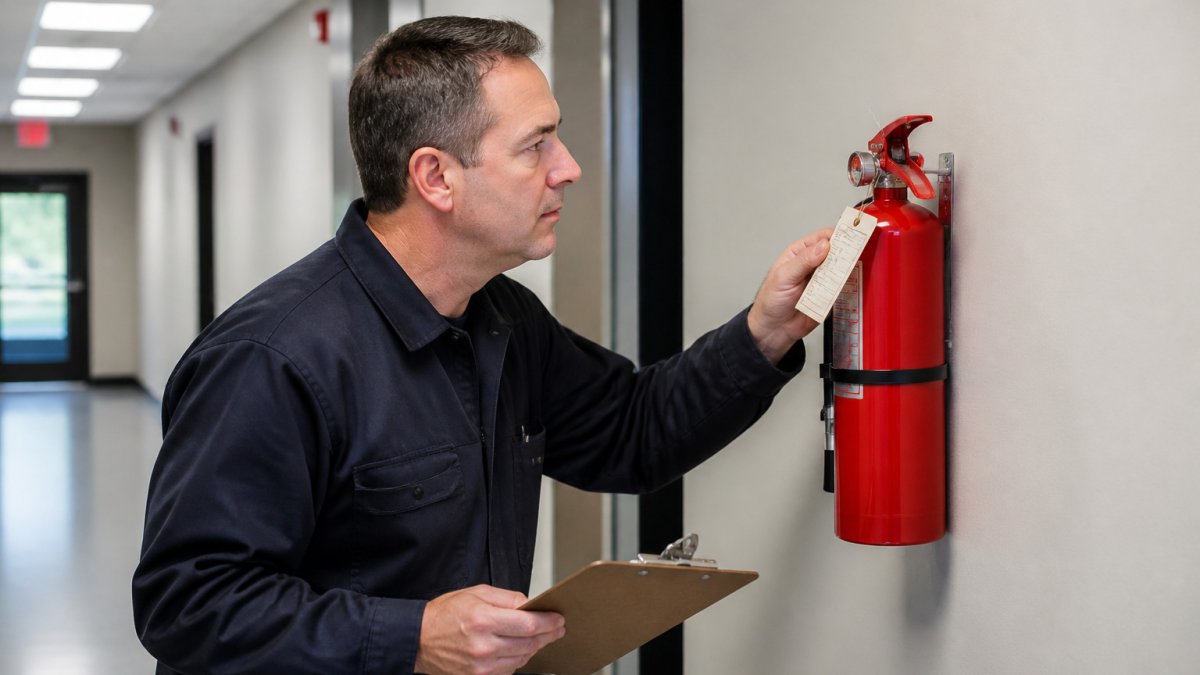
Portable extinguishers follow the most granular schedule of any fire protection asset because they are the most numerous, most frequently handled, and most often discharged. NFPA 10, Standard for Portable Fire Extinguishers, separates four obligations that are easy to conflate: monthly visual inspection, annual maintenance, hydrostatic testing, and replacement. Only the last two retire a cylinder.
The four obligations, separated
- Monthly visual inspection: A designated employee checks the gauge, tamper seal, pin, nozzle, and condition. A walk-and-look task, not a service call.
- Annual maintenance: A qualified technician examines the gauge, hose, and valve assembly and records the result on the unit's tag.
- Hydrostatic testing: The cylinder is pressure-tested to verify the shell can still contain the agent safely. This is the event that most often drives replacement.
- Replacement: The unit is retired and a new one installed. Replacement is mandatory after a failed hydrostatic test, after certain discharges, and at the end of the manufacturer's rated service life.
Hydrostatic test intervals by cylinder type
| Cylinder / agent type | Hydrostatic test interval |
|---|---|
| Stored-pressure dry chemical (welded or brazed steel) | 12 years from manufacture |
| Stored-pressure dry chemical (certain cylinder types) | 5 years |
| Carbon dioxide (CO2) | 5 years |
| Clean agent (Halotron and similar) | 5 years |
| Water and foam | 5 years |
The replacement decision, step by step
- Read the manufacture date stamped on the cylinder nameplate or collar. That date, not the purchase date, starts the clock.
- Identify the cylinder type and agent so you apply the correct hydrostatic interval.
- Check the last hydrostatic test date on the test tag or collar stamp. If the interval has elapsed, the unit is due for testing, and a failed test means replacement.
- Inspect the shell for dents, corrosion, or repairs that are not permitted. A corroded or dented shell is a replacement trigger regardless of test status.
- Confirm the discharge history. A unit that has been discharged and not recharged, or one with a broken seal and unknown history, should be replaced rather than recharged.
- Log the retirement and the new unit's serial number and install date in your maintenance record.
Match the replacement to the hazard
The Fire Extinguisher Cabinets - JL Industries Academy Series are listed at $221.00. The Fire Extinguisher - Buckeye ABC Dry Chemical is listed at $65.00 and is described for Class A, B, and C fires. The Fire Extinguisher - Buckeye Carbon Dioxide (CO2) is listed at $199.00 and is recommended for sensitive electronic equipment. The Fire Extinguisher - Buckeye Halotron is listed at $368.00 and is also recommended for sensitive electronic equipment.


Fire Alarm System Replacement Guidelines
Replacement generally falls into three categories:
- Individual devices: Smoke and heat detectors are replaced on age or when they fail sensitivity testing. Replace like-for-like where possible to avoid compatibility issues with the panel.
- Batteries: Secondary batteries should be load-tested and replaced on the manufacturer's interval, usually every 3 to 5 years.
- Control panels: Panels are replaced when parts become unavailable, when the manufacturer discontinues support, or when a building change exceeds the existing system's capacity.
Signs Fire Protection Equipment Needs Replacement
Scheduled replacement handles most cases, but certain signs mean you should act before the interval expires:
- Failed inspection or test: A hydrostatic test failure, a failed detector sensitivity test, or a non-functioning sprinkler valve requires immediate action.
- Corrosion or physical damage: Rust through a cylinder shell, cracked detector housings, or a dented extinguisher body are replacement triggers regardless of age.
- Obsolescence: If the manufacturer has discontinued a component, you may not be able to repair it, and parts may become unavailable.
- Repeated repair: A device that needs frequent repair often costs more over its remaining life than a new unit.
- Building changes: Renovations, added square footage, or changed occupancy can exceed a system's design capacity and require replacement or expansion.
- Documentation gaps: Equipment without a readable manufacture date or test record is hard to certify and should be scheduled for replacement.
Repair Versus Replace: Lifecycle Cost Decisions
A repair-versus-replace decision can compare the remaining cost of keeping an asset against the cost of replacing it.
Fire Extinguisher Cabinets – JL Industries Academy Series →
The four cost buckets to compare
- Direct repair cost: Parts and labor for the immediate fix, plus any recertification the repair triggers.
- Expected future repair cost: The repairs you are likely to face over the asset's remaining life. A unit with a history of repeated faults will keep generating them; a unit with one isolated fault may not.
- Downtime and disruption cost: The cost of taking the system or space out of service, including temporary coverage, lost use of the area, and staff time to manage the outage.
- Replacement cost, net of residual value: The new unit's price plus installation and commissioning, minus any salvage or trade-in value and minus the avoided future repair and downtime costs.
A practical decision sequence
- Establish remaining service life. Use the manufacturer's rated life and the hydrostatic or test schedule. A repair on an asset with one year remaining is rarely worth it; the same repair with ten years remaining often is.
- Estimate the repair-to-replacement ratio. A repair approaching or exceeding half the replacement cost on an asset with limited life left is usually a poor investment. Treat the ratio as a screen, not a verdict, the cost buckets above decide the case.
- Check parts availability. A discontinued component may make repair impossible or require a substitute that fails inspection. Obsolescence alone can force replacement even when the repair looks cheap.
- Weigh reliability and risk. A device that has failed once and been repaired is more likely to fail again. For life-safety equipment, the cost of a second failure during an emergency is not measurable in repair dollars, which biases the decision toward replacement once a pattern of faults appears.
- Confirm the repair restores full rated performance. A fix that brings a unit back to partial function is a deferral, not a repair. If it does not restore the listed rating, replace.
When repair is the right call
Repair makes sense when the asset is young relative to its rated life, the fault is isolated and well understood, parts are readily available, the repair restores full rated performance, and downtime is short. In those cases, repair preserves capital and keeps a functioning asset in service.
When replacement wins
Replacement is typically the lower-risk choice when the asset is near or past its rated life; the repair cost approaches half the replacement cost; parts are discontinued or lead times are long; the unit has a history of repeated faults; the repair does not restore full rated performance; or repair downtime exceeds swap downtime. Replacement also resets the warranty clock and simplifies the documentation trail, which matters at inspection time.
Feed the decision back into the cycle plan
Every repair-versus-replace call is a data point for your replacement schedule. Log the decision, reasoning, and cost so next year's plan reflects what you learned about each asset's reliability. Over two or three cycles, that log turns a generic interval table into a schedule tuned to your buildings, environment, and failure patterns.
Building an Inspection Checklist and Maintenance Log
Keep the log in a format your team will update. A spreadsheet works for smaller portfolios, and a computerized maintenance system suits larger ones. What matters is that every replacement traces back to a dated record.
Planning Your Next Equipment Replacement Cycle
For buyers sourcing replacement units, Victory Construction Products offers fire protection equipment. Build your replacement schedule around applicable requirements, manufacturer information, and inspection findings.
Frequently Asked Questions
How often should fire protection equipment be replaced?
Replacement timing depends on equipment type, manufacturer information, and inspection findings.
What is the service life of a fire extinguisher?
Most portable fire extinguishers have a service life tied to the manufacturer's stated limit, often around 10 to 12 years for many stored-pressure models, after which they must be replaced rather than recharged. Cylinders also require hydrostatic testing at intervals set by NFPA 10 and the manufacturer, and a failed test or visible corrosion, dents or damage ends the unit's service. Check the date stamped on the cylinder and the service tag before assuming a unit remains usable.
When should a fire alarm system be replaced?
A fire alarm system should be considered for replacement when the control panel is no longer supported by the manufacturer, replacement parts are discontinued, the system cannot accommodate building changes, or repeated failures make repair impractical. Systems also need replacement planning when they no longer meet current NFPA 72 requirements for the occupancy. Document the age of the panel and devices, and budget for a full evaluation before the system reaches end of life.
Can fire protection equipment be repaired instead of replaced?
Some components can be repaired, such as recharging a rechargeable extinguisher, replacing a faulty smoke detector head or correcting a sprinkler head that was damaged but is still listed for service. Other failures, such as corroded cylinders, obsolete control panels or a system whose capacity no longer fits the building, usually justify replacement. Compare the cost of repeated repairs against the price of a new unit over its remaining service life, and confirm any repair is performed by a qualified technician.
How do you create a fire equipment replacement schedule?
Start by inventorying every fire protection device with its installation date, manufacturer, model and service life. Map each item to the inspection, testing and replacement intervals in NFPA 10, NFPA 25 and NFPA 72 as applicable, then set calendar reminders for each replacement date. Review the schedule annually, update it after any building renovation, and keep the inspection records together so you can demonstrate compliance during a fire marshal or insurer review.
